
Ch. 6 - Confidence Intervals
Larson - Elementary Statistics: Picturing the World 8th Edition
Larson8th EditionElementary Statistics: Picturing the WorldISBN: 9780137493470당신이 사용하는 게 아니라요?교과서 변경
6장, 문제 6.3.9

In Exercises 7–10, use the confidence interval to find the margin of error and the sample proportion.
(0.512, 0.596)

검증된 단계별 안내
1
Identify the given confidence interval, which is (0.512, 0.596). The lower bound is 0.512, and the upper bound is 0.596.
To find the margin of error (E), use the formula: E = \(\frac{\text{Upper Bound}\) - \(\text{Lower Bound}\)}{2}. Substitute the values of the upper and lower bounds into this formula.
To find the sample proportion (p̂), use the formula: \(\hat{p}\) = \(\frac{\text{Upper Bound}\) + \(\text{Lower Bound}\)}{2}. Substitute the values of the upper and lower bounds into this formula.
Perform the subtraction and division in the margin of error formula to calculate E.
Perform the addition and division in the sample proportion formula to calculate p̂.

비슷한 문제에 대한 검증된 영상 답변:

이 영상 해법은 위 문제에 도움이 된다고 튜터들이 추천한 것입니다.
영상 길이:
1m
도움이 되었나요?

주요 개념

질문에 올바르게 답하기 위해 반드시 이해해야 하는 핵심 개념들은 다음과 같습니다.

Confidence Interval

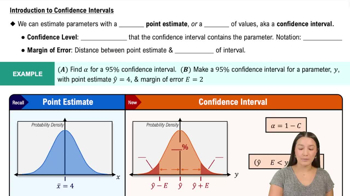
A confidence interval is a range of values, derived from sample statistics, that is likely to contain the true population parameter. It is expressed as an interval (e.g., (0.512, 0.596)) and is associated with a confidence level, typically 95% or 99%. This means that if we were to take many samples and construct confidence intervals for each, a certain percentage of those intervals would contain the true parameter.
추천 영상:
가이드 코스
06:33
Introduction to Confidence Intervals

Margin of Error

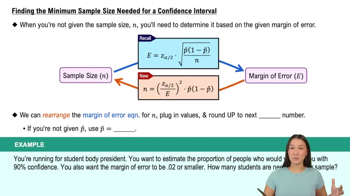
The margin of error quantifies the uncertainty associated with a sample estimate. It is calculated as half the width of the confidence interval, representing the maximum expected difference between the sample proportion and the true population proportion. In the given interval (0.512, 0.596), the margin of error can be found by subtracting the lower limit from the upper limit and dividing by two.
추천 영상:
가이드 코스
04:08
Finding the Minimum Sample Size Needed for a Confidence Interval

Sample Proportion

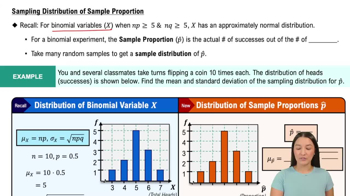
The sample proportion is the ratio of the number of successes in a sample to the total number of observations in that sample. It is denoted as 'p̂' and provides an estimate of the true population proportion. In the context of the confidence interval (0.512, 0.596), the sample proportion can be calculated as the midpoint of the interval, which gives a point estimate of the population proportion.
추천 영상:
가이드 코스
05:11
Sampling Distribution of Sample Proportion