Ch. 9 - Correlation and Regression
Larson - Elementary Statistics: Picturing the World 8th Edition
Larson8th EditionElementary Statistics: Picturing the WorldISBN: 9780137493470당신이 사용하는 게 아니라요?교과서 변경
9장, 문제 9.1.2

2. Describe the range of values for the correlation coefficient.

검증된 단계별 안내
1
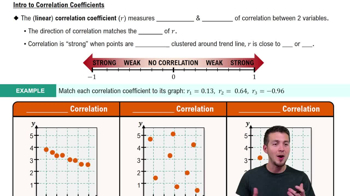
Understand that the correlation coefficient, often denoted as r, measures the strength and direction of the linear relationship between two variables.
Recognize that the correlation coefficient is a value that ranges between -1 and 1, inclusive.
Interpret the values: r = -1 indicates a perfect negative linear relationship, r = 1 indicates a perfect positive linear relationship, and r = 0 indicates no linear relationship.
Understand that values closer to -1 or 1 indicate stronger linear relationships, while values closer to 0 indicate weaker linear relationships.
Note that the correlation coefficient does not imply causation; it only quantifies the degree of linear association between two variables.

비슷한 문제에 대한 검증된 영상 답변:

이 영상 해법은 위 문제에 도움이 된다고 튜터들이 추천한 것입니다.
영상 길이:
2m
도움이 되었나요?

주요 개념

질문에 올바르게 답하기 위해 반드시 이해해야 하는 핵심 개념들은 다음과 같습니다.

Correlation Coefficient

The correlation coefficient is a statistical measure that describes the strength and direction of a relationship between two variables. It is denoted by 'r' and can take values between -1 and 1. A value of 1 indicates a perfect positive correlation, -1 indicates a perfect negative correlation, and 0 indicates no correlation.
추천 영상:
가이드 코스
05:43
Correlation Coefficient

Range of Values

The range of values for the correlation coefficient is crucial for interpreting the degree of association between variables. Specifically, values closer to 1 or -1 signify a stronger relationship, while values near 0 suggest a weak or nonexistent relationship. Understanding this range helps in assessing the reliability of predictions based on the correlation.
추천 영상:
07:10
Empirical Rule of Standard Deviation and Range Rule of Thumb

Interpretation of Correlation

Interpreting the correlation coefficient involves understanding not just the strength but also the direction of the relationship. A positive correlation means that as one variable increases, the other tends to increase as well, while a negative correlation indicates that as one variable increases, the other tends to decrease. This interpretation is essential for making informed conclusions about the data.
추천 영상:
가이드 코스
05:43
Correlation Coefficient