
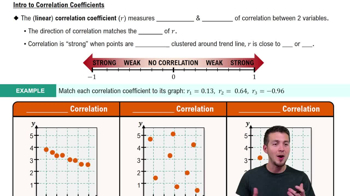
Graphical Analysis In Exercises 11–14, determine whether there is a perfect positive linear correlation, a strong positive linear correlation, a perfect negative linear correlation, a strong negative linear correlation, or no linear correlation between the variables.
Ch. 9 - Correlation and Regression
Larson8th EditionElementary Statistics: Picturing the WorldISBN: 9780137493470당신이 사용하는 게 아니라요?교과서 변경
9장, 문제 9.3.5
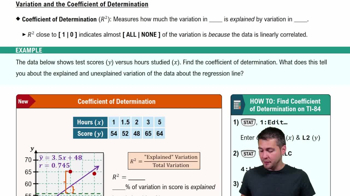
What is the coefficient of determination for two variables that have perfect positive linear correlation or perfect negative linear correlation? Interpret your answer.
검증된 단계별 안내1
Recall that the coefficient of determination, denoted as , is the square of the correlation coefficient . It measures the proportion of variance in one variable that is predictable from the other variable.
Understand that a perfect positive linear correlation means the correlation coefficient , and a perfect negative linear correlation means .
Calculate the coefficient of determination by squaring the correlation coefficient: . For both and , this will be .
Interpret the coefficient of determination value of 1 as indicating that 100% of the variance in one variable is explained by the variance in the other variable, meaning a perfect linear relationship.
Conclude that whether the correlation is perfectly positive or perfectly negative, the coefficient of determination is 1, showing a perfect linear association in terms of explained variance.

비슷한 문제에 대한 검증된 영상 답변:
이 영상 해법은 위 문제에 도움이 된다고 튜터들이 추천한 것입니다.
영상 길이:
3m도움이 되었나요?
주요 개념
질문에 올바르게 답하기 위해 반드시 이해해야 하는 핵심 개념들은 다음과 같습니다.
Coefficient of Determination (R²)
The coefficient of determination, denoted as R², measures the proportion of variance in the dependent variable that is predictable from the independent variable. It ranges from 0 to 1, where 1 indicates perfect prediction and 0 indicates no predictive power.
추천 영상:
가이드 코스
Coefficient of Determination
Correlation Coefficient (r)
The correlation coefficient, r, quantifies the strength and direction of a linear relationship between two variables. It ranges from -1 (perfect negative linear correlation) to +1 (perfect positive linear correlation), with 0 indicating no linear correlation.
추천 영상:
가이드 코스
Correlation Coefficient
Relationship Between R² and r
The coefficient of determination R² is the square of the correlation coefficient r. For perfect positive (r = +1) or perfect negative (r = -1) linear correlation, R² equals 1, meaning the model explains 100% of the variance in the data regardless of the correlation's direction.
추천 영상:
가이드 코스
Probabilities Between Two Values
관련 실천
교과서 질문
65
views
교과서 질문
In Exercise 23, add data for a child who is 6 years old and has a vocabulary of 900 words. Describe how this affects the correlation coefficient r.
54
views
교과서 질문
2. Compare the numbers of dependent and independent variables in a multiple regression equation and a single regression equation.
80
views
교과서 질문
The coefficient of determination r^2 is the ratio of which two types of variations? What does r^2 measure? What does 1 - r^2 measure?
147
views
교과서 질문
6. Why is it not appropriate to use a regression line to predict y-values for x-values that are not in (or close to) the range of x-values found in the data?
299
views
교과서 질문
"Old Vehicles In Exercises 31–34, use the figure shown at the left.
Error of Estimate Find the standard error of estimate Se and interpret the results."
57
views
