Ch. 1 - Introduction to Statistics
Triola - Elementary Statistics 14th Edition
Triola14th EditionElementary StatisticsISBN: 9780137366446당신이 사용하는 게 아니라요?교과서 변경
1장, 문제 1.CRE.12

In Exercises 9–12, the given expressions are designed to yield results expressed in a form of scientific notation. For example, the calculator-displayed result of 1.23E5 can be expressed as 123,000, and the result of 1.23E-4 can be expressed as 0.000123. Perform the indicated operation and express the result as an ordinary number that is not in scientific notation.


(0.2)^12

검증된 단계별 안내
1
Understand the problem: You need to calculate the value of (0.2)^12 and express the result as an ordinary number, not in scientific notation.
Recognize that (0.2)^12 involves exponentiation, where 0.2 is the base and 12 is the exponent. This means you multiply 0.2 by itself 12 times.
Use a calculator to perform the operation: Enter 0.2 and use the exponentiation function to raise it to the power of 12.
Once you have the result from the calculator, check if it is displayed in scientific notation. If it is, convert it to an ordinary number by moving the decimal point according to the exponent.
Write down the final result as an ordinary number, ensuring that it is not in scientific notation, and verify the accuracy of your conversion.

비슷한 문제에 대한 검증된 영상 답변:

이 영상 해법은 위 문제에 도움이 된다고 튜터들이 추천한 것입니다.
영상 길이:
3m
도움이 되었나요?

주요 개념

질문에 올바르게 답하기 위해 반드시 이해해야 하는 핵심 개념들은 다음과 같습니다.

Scientific Notation

Scientific notation is a way of expressing numbers that are too large or too small to be conveniently written in decimal form. It is typically used in scientific and engineering contexts. A number is expressed in the form of a × 10^n, where 1 ≤ a < 10 and n is an integer. For example, 1.23E5 represents 123,000.
추천 영상:
가이드 코스
08:24
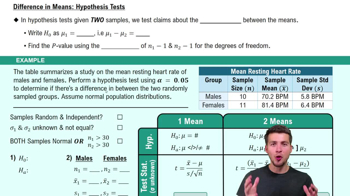
Difference in Means: Hypothesis Tests

Exponentiation

Exponentiation is a mathematical operation involving two numbers, the base and the exponent. The operation is written as b^n, where b is the base and n is the exponent, meaning b is multiplied by itself n times. For example, (0.2)^12 means multiplying 0.2 by itself 12 times, which is crucial for solving the given expression.

Converting Scientific Notation to Decimal

Converting scientific notation to a decimal involves moving the decimal point to the right for positive exponents or to the left for negative exponents, based on the power of ten. For instance, 1.23E-4 is converted to 0.000123 by moving the decimal point four places to the left, which is essential for expressing results in ordinary numbers.
추천 영상:
가이드 코스
08:24
Difference in Means: Hypothesis Tests
관련 실천
교과서 질문

Physicians’ Health Study In the Physicians’ Health Study, some of the subjects were treated with aspirin while others were given a placebo. For the subjects in this experiment, what is blinding?

272
views

교과서 질문

Survey Which of the following best describes the level of measurement of the numbers 1, 2, 3, . . . , 410 described in Exercise 1: nominal, ordinal, interval, ratio?

344
views
교과서 질문

Percentages

c. In a Pew Research Center poll on driving, 331 of the 1182 respondents said that driving is a chore. What percentage of respondents said that driving is a chore?

251
views
교과서 질문

In Exercises 9–12, the given expressions are designed to yield results expressed in a form of scientific notation. For example, the calculator-displayed result of 1.23E5 can be expressed as 123,000, and the result of 1.23E-4 can be expressed as 0.000123. Perform the indicated operation and express the result as an ordinary number that is not in scientific notation.


(8)^12

252
views
교과서 질문

Birth Weights For 100 randomly selected births from Bellevue Hospital Center, the birth weights are added and then divided by 100. The result is 3240 g. Is the value of 3240 g a statistic or a parameter?

294
views
교과서 질문

Types of Data In each of the following, identify the level of measurement of the sample data (nominal, ordinal, interval, ratio) and the type of sampling used to obtain the data (random, systematic, convenience, stratified, cluster).


b. In each of the 50 states, 50 voters are randomly selected and their political party affiliations are identified.

280
views