

Ch. 12 - Analysis of Variance
Triola - Elementary Statistics 14th Edition
Triola14th EditionElementary StatisticsISBN: 9780137366446당신이 사용하는 게 아니라요?교과서 변경
12장, 문제 12.R.3

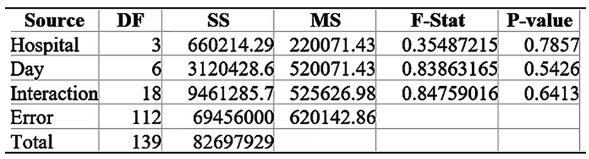
Birth Weights Data Set 6 “Births” includes birth weights (g), hospitals, and the day of the week that mothers were admitted to the hospital. Using rows to represent the four hospitals (Albany Medical Center, Bellevue Hospital Center, Olean General Hospital, Strong Memorial Hospital), and using columns to represent the seven different days of the week, a two-way table has 28 individual cells. Using five birth weights for each of those 28 cells and using StatCrunch for two-way analysis of variance, we get the results displayed below. What do you conclude?
ANOVA table showing degrees of freedom, sum of squares, mean squares, F-statistics, and p-values for hospital, day, and interaction effects.

검증된 단계별 안내
1
Step 1: Understand the setup of the two-way ANOVA. Here, we have two factors: Hospital (with 4 levels) and Day (with 7 levels), and their interaction. The goal is to determine if there are significant differences in birth weights based on these factors and their interaction.
Step 2: Examine the ANOVA table components. The table provides degrees of freedom (DF), sum of squares (SS), mean squares (MS), F-statistics, and p-values for each source of variation: Hospital, Day, Interaction, and Error.
Step 3: Interpret the p-values for each factor and their interaction. The p-value indicates the probability of observing the data if the null hypothesis (no effect) is true. Typically, a p-value less than 0.05 suggests a statistically significant effect.
Step 4: Compare the p-values for Hospital (0.7857), Day (0.5426), and Interaction (0.6413) to the significance level (usually 0.05). Since all p-values are greater than 0.05, we fail to reject the null hypotheses for all factors, indicating no significant differences in birth weights due to hospital, day, or their interaction.
Step 5: Conclude that based on this two-way ANOVA, there is no sufficient evidence to say that birth weights differ by hospital, day of the week, or the interaction between hospital and day.

비슷한 문제에 대한 검증된 영상 답변:

이 영상 해법은 위 문제에 도움이 된다고 튜터들이 추천한 것입니다.
영상 길이:
3m
도움이 되었나요?

주요 개념

질문에 올바르게 답하기 위해 반드시 이해해야 하는 핵심 개념들은 다음과 같습니다.

Two-Way ANOVA

Two-way ANOVA is a statistical method used to examine the effect of two categorical independent variables on a continuous dependent variable. It also tests for interaction effects between the two factors, helping to understand if the effect of one factor depends on the level of the other.
추천 영상:
05:31
ANOVA Test

F-Statistic and P-Value

The F-statistic measures the ratio of variance explained by a factor to the unexplained variance (error). The p-value indicates the probability that the observed F-statistic would occur if the null hypothesis were true. A small p-value (typically < 0.05) suggests a significant effect.
추천 영상:
가이드 코스
06:50
Step 3: Get P-Value

Interaction Effect

An interaction effect occurs when the impact of one independent variable on the dependent variable changes depending on the level of the other independent variable. Detecting interaction is crucial because it indicates that the factors do not operate independently.
추천 영상:
03:33
Finding Binomial Probabilities Using TI-84 Example 1
관련 실천
교과서 질문

Bonferroni Test Shown below are weights (kg) of poplar trees obtained from trees planted in a rich and moist region. The trees were given different treatments identified in the table below. The data are from a study conducted by researchers at Pennsylvania State University and were provided by Minitab, Inc. Also shown are partial results from using the Bonferroni test with the sample data.

a. Use a 0.05 significance level to test the claim that the different treatments result in the same mean weight.

33
views
교과서 질문

Birth Weights The table below lists some of the same data used in the preceding exercise, but the seven days of the week are combined into weekday (Monday, Tuesday, Wednesday, Thursday, Friday) and weekend days (Saturday, Sunday). Also, the birth weights are converted to kilograms. What do you conclude?

128
views
교과서 질문

Pulse Rates Shown below are pulse rates from Data Set 1 “Body Data” in Appendix B, and the StatCrunch display from two-way analysis of variance of these data. In analyzing these data, what important feature is addressed with two-way analysis of variance that is not addressed with two separate tests of (1) difference between mean pulse rates based on gender, or (2) differences among the mean pulse rates in the different age brackets?

53
views
교과서 질문

One vs. Two What is the fundamental difference between one-way analysis of variance and two-way analysis of variance?

104
views
교과서 질문

In Exercises 1–4, use the following listed measured amounts of chest compression (mm) from car crash tests (from Data Set 35 “Car Data” in Appendix B). Also shown are the SPSS results from analysis of variance. Assume that we plan to use a 0.05 significance level to test the claim that the different car sizes have the same mean amount of chest compression.


Anova


a. What characteristic of the data above indicates that we should use one-way analysis of variance?

120
views
교과서 질문

Interaction

b. If there does appear to be an interaction between gender and age bracket, how should we continue with the procedure for two-way analysis of variance?

58
views