
Ch. 4 - Probability
Triola - Elementary Statistics 14th Edition
Triola14th EditionElementary StatisticsISBN: 9780137366446당신이 사용하는 게 아니라요?교과서 변경
4장, 문제 4.1.36

In Exercises 33–40, use the given probability value to determine whether the sample results are significant.


Voting Repeat Exercise 33 after replacing 40 Democrats being placed on the first line of voting ballots with 27 Democrats being placed on the first line. The probability of getting a result as high as 27 is 0.029792.

검증된 단계별 안내
1
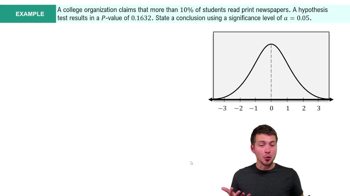
Identify the given probability value, which is 0.029792, and compare it to the commonly used significance level (α), such as 0.05 or 0.01. This will help determine whether the result is statistically significant.
Recall the rule for statistical significance: If the probability (p-value) is less than or equal to the significance level (α), the result is considered statistically significant. Otherwise, it is not significant.
State the null hypothesis (H₀) and the alternative hypothesis (H₁). For this problem, H₀ might state that the placement of Democrats on the first line is random, while H₁ might suggest that it is not random.
Compare the given probability (0.029792) to the chosen significance level (e.g., 0.05). If 0.029792 ≤ 0.05, reject the null hypothesis (H₀). If 0.029792 > 0.05, fail to reject H₀.
Conclude whether the result of 27 Democrats being placed on the first line is statistically significant based on the comparison. If significant, it suggests that the placement may not be random; if not significant, it suggests the placement could be due to chance.

비슷한 문제에 대한 검증된 영상 답변:

이 영상 해법은 위 문제에 도움이 된다고 튜터들이 추천한 것입니다.
영상 길이:
4m
도움이 되었나요?

주요 개념

질문에 올바르게 답하기 위해 반드시 이해해야 하는 핵심 개념들은 다음과 같습니다.

Significance Level

The significance level, often denoted as alpha (α), is a threshold used in hypothesis testing to determine whether to reject the null hypothesis. Commonly set at 0.05, it represents the probability of making a Type I error, which occurs when a true null hypothesis is incorrectly rejected. In this context, if the probability value (p-value) is less than α, the results are considered statistically significant.
추천 영상:
가이드 코스
04:46
Step 4: State Conclusion Example 4

P-value

The p-value is a statistical measure that helps determine the strength of the evidence against the null hypothesis. It quantifies the probability of observing results as extreme as, or more extreme than, the actual observed results, assuming the null hypothesis is true. A low p-value (typically less than 0.05) indicates strong evidence against the null hypothesis, suggesting that the observed effect is statistically significant.
추천 영상:
가이드 코스
06:50
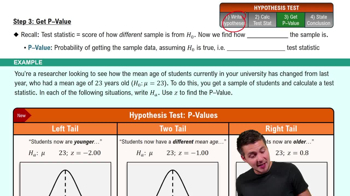
Step 3: Get P-Value

Hypothesis Testing

Hypothesis testing is a statistical method used to make inferences about population parameters based on sample data. It involves formulating a null hypothesis (H0) and an alternative hypothesis (H1), then using sample data to determine whether to reject H0 in favor of H1. The process includes calculating the p-value and comparing it to the significance level to assess the validity of the hypotheses.
추천 영상:
가이드 코스
06:21
Step 1: Write Hypotheses
관련 실천
교과서 질문

In Exercises 9–20, use the data in the following table, which lists survey results from high school drivers at least 16 years of age (based on data from “Texting While Driving and Other Risky Motor Vehicle Behaviors Among U.S. High School Students,” by O’Malley, Shults, and Eaton, Pediatrics, Vol. 131, No. 6). Assume that subjects are randomly selected from those included in the table. Hint: Be very careful to read the question correctly.

Drinking and Driving If one of the high school drivers is randomly selected, find the probability of getting one who drove when drinking alcohol.

97
views
교과서 질문

Same Birthdays If 25 people are randomly selected, find the probability that no 2 of them have the same birthday. Ignore leap years.

215
views
교과서 질문

Simulating Dice When two dice are rolled, the total is between 2 and 12 inclusive. A student simulates the rolling of two dice by randomly generating numbers between 2 and 12. Does this simulation behave in a way that is similar to actual dice? Why or why not?

246
views
교과서 질문

Computer Variable Names A common computer programming rule was that names of variables must be between one and eight characters long. The first character can be any of the 26 letters, while successive characters can be any of the 26 letters or any of the 10 digits. For example, allowable variable names include A, BBB, and M3477K. How many different variable names are possible? (Ignore the difference between uppercase and lowercase letters.)

235
views
교과서 질문

In Exercises 33–40, use the given probability value to determine whether the sample results are significant.


Selfie Deaths Based on Priceonomics data describing 49 deaths while taking selfies, it was found that 37 of those deaths were males. Assuming that males and females are equally likely to have selfie deaths, there is a 0.000235 probability of getting 37 or more males. Is the result of 37 males significantly low, significantly high, or neither? Does the result suggest that male selfie deaths are more likely than female selfie deaths?

126
views
교과서 질문

In Exercises 9–12, assume that 100 births are randomly selected. Use subjective judgment to describe the given number of girls as (a) significantly low, (b) significantly high, or (c) neither significantly low nor significantly high.


53 girls.

126
views