
Ch. 4 - Probability
Triola - Elementary Statistics 14th Edition
Triola14th EditionElementary StatisticsISBN: 9780137366446당신이 사용하는 게 아니라요?교과서 변경
4장, 문제 4.3.25

Shared Birthdays Find the probability that of 25 randomly selected people, at least 2 share the same birthday.

검증된 단계별 안내
1
Step 1: Understand the problem. We are tasked with finding the probability that at least two people out of 25 randomly selected individuals share the same birthday. This is a classic application of the 'Birthday Problem' in probability theory.
Step 2: Use the complement rule. Instead of directly calculating the probability of at least two people sharing a birthday, calculate the probability that no two people share a birthday (the complement event). Then subtract this value from 1 to find the desired probability.
Step 3: Assume there are 365 days in a year (ignoring leap years). For the first person, there are 365 possible birthdays. For the second person, to avoid sharing a birthday with the first, there are 364 possible birthdays. For the third person, there are 363 possible birthdays, and so on.
Step 4: Calculate the probability that no two people share a birthday. Multiply the probabilities for each person: \( P(\text{no shared birthdays}) = \frac{365}{365} \times \frac{364}{365} \times \frac{363}{365} \times \ldots \times \frac{341}{365} \). This product represents the probability that all 25 people have unique birthdays.
Step 5: Subtract the result from 1 to find the probability of at least two people sharing a birthday: \( P(\text{at least two share a birthday}) = 1 - P(\text{no shared birthdays}) \).

비슷한 문제에 대한 검증된 영상 답변:

이 영상 해법은 위 문제에 도움이 된다고 튜터들이 추천한 것입니다.
영상 길이:
3m
도움이 되었나요?

주요 개념

질문에 올바르게 답하기 위해 반드시 이해해야 하는 핵심 개념들은 다음과 같습니다.

Probability

Probability is a measure of the likelihood that a particular event will occur, expressed as a number between 0 and 1. In the context of the birthday problem, it quantifies the chance that at least two individuals in a group share the same birthday, which can be counterintuitive due to the large number of possible combinations.
추천 영상:
5:37
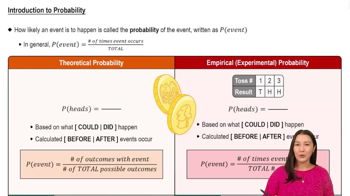
Introduction to Probability

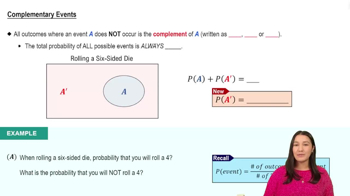
Complementary Events

Complementary events are pairs of outcomes where one event occurs if and only if the other does not. In the birthday problem, instead of directly calculating the probability of at least two people sharing a birthday, it is often easier to calculate the probability that no one shares a birthday and then subtract this from 1.
추천 영상:
4:23
Complementary Events

Combinatorics

Combinatorics is a branch of mathematics dealing with combinations and arrangements of objects. In the birthday problem, it helps determine the number of ways to assign birthdays to individuals, which is crucial for calculating the probabilities involved in determining shared birthdays among a group.
관련 실천
교과서 질문

Unseen Coins A statistics professor tosses two coins that cannot be seen by any students. One student asks this question: “Did one of the coins turn up heads?” Given that the professor’s response is “yes,” find the probability that both coins turned up heads.

130
views
교과서 질문

California Lottery Let A denote the event of placing a \$1 straight bet on the California Daily 4 lottery and winning. There are 10,000 different ways that you can select the four digits (with repetition allowed) in this lottery, and only one of those four-digit numbers will be the winner. What is the value of P(A)? What is the value of P(Abar)?

238
views
교과서 질문

Laundry Symbols Based on a New Generation of Stains survey, 13% of U.S. adults know that the care-instruction symbol on clothing means that any bleach can be used. Find the probability of randomly selecting an adult in the U.S. who does not know that.

158
views
교과서 질문

Language: Complement of “At Least One” Let A=the event of getting at least one defective calculator when four are randomly selected with replacement from a batch. Write a statement describing event A

195
views
교과서 질문

In Exercises 13–20, express the indicated degree of likelihood as a probability value between 0 and 1.


Square Peg Sydney Smith wrote in “On the Conduct of the Understanding” that it is impossible to fit a square peg in a round hole.

131
views
교과서 질문

Jumble Many newspapers carry “Jumble,” a puzzle in which the reader must unscramble letters to form words. The letters MHRHTY were included in newspapers on the day this exercise was written. How many ways can those letters be arranged? Identify the correct unscrambling, then determine the probability of getting that result by randomly selecting one arrangement of the given letters.

207
views