
Ch. 5 - Discrete Probability Distributions
Triola - Elementary Statistics 14th Edition
Triola14th EditionElementary StatisticsISBN: 9780137366446당신이 사용하는 게 아니라요?교과서 변경
5장, 문제 5.2.40b

One of Mendel’s famous experiments with peas resulted in 580 offspring, and 152 of them were yellow peas. Mendel claimed that under the same conditions, 25% of offspring peas would be yellow. Assume that Mendel’s claim of 25% is true, and assume that a sample consists of 580 offspring peas.


b. Find the probability of exactly 152 yellow peas.

검증된 단계별 안내
1
Step 1: Identify the type of probability distribution to use. Since we are dealing with a fixed number of trials (580 peas), each trial has two possible outcomes (yellow or not yellow), and the probability of success (yellow pea) is constant (25%), this is a binomial probability problem.
Step 2: Write the formula for the binomial probability distribution. The probability of exactly k successes in n trials is given by: P(X = k) = C(n, k) * pk * (1 - p)n-k, where C(n, k) is the binomial coefficient, p is the probability of success, and n is the number of trials.
Step 3: Substitute the given values into the formula. Here, n = 580 (total peas), k = 152 (yellow peas), and p = 0.25 (probability of a yellow pea). The binomial coefficient C(n, k) is calculated as: C(n, k) = n! / (k! * (n - k)!).
Step 4: Compute the binomial coefficient C(580, 152). This involves factorial calculations for 580, 152, and (580 - 152). Then, multiply the result by pk and (1 - p)n-k.
Step 5: Use a calculator or statistical software to evaluate the final probability. Since factorials for large numbers can be computationally intensive, it is often practical to use software or a binomial probability table to find the result.

비슷한 문제에 대한 검증된 영상 답변:

이 영상 해법은 위 문제에 도움이 된다고 튜터들이 추천한 것입니다.
영상 길이:
3m
도움이 되었나요?

주요 개념

질문에 올바르게 답하기 위해 반드시 이해해야 하는 핵심 개념들은 다음과 같습니다.

Binomial Distribution

The binomial distribution models the number of successes in a fixed number of independent Bernoulli trials, each with the same probability of success. In this context, the 'success' is the occurrence of yellow peas, with a probability of 25%. The distribution is defined by two parameters: the number of trials (n) and the probability of success (p).
추천 영상:
가이드 코스
03:28
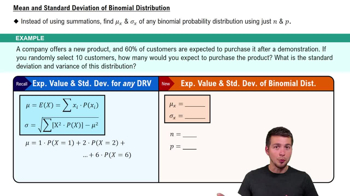
Mean & Standard Deviation of Binomial Distribution

Probability Mass Function (PMF)

The probability mass function gives the probability of obtaining exactly k successes in n trials for a binomial distribution. It is calculated using the formula P(X = k) = (n choose k) * p^k * (1-p)^(n-k). This function is essential for determining the likelihood of observing exactly 152 yellow peas out of 580.
추천 영상:
가이드 코스
5:37
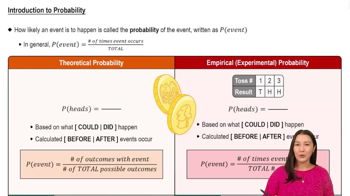
Introduction to Probability

Hypothesis Testing

Hypothesis testing is a statistical method used to make inferences about population parameters based on sample data. In this scenario, we can test Mendel's claim that 25% of the offspring are yellow peas by comparing the observed number of yellow peas (152) to the expected number based on the binomial distribution. This helps assess whether the observed result is consistent with the hypothesis.
추천 영상:
가이드 코스
06:21
Step 1: Write Hypotheses
관련 실천
교과서 질문

In Exercises 29 and 30, assume that different groups of couples use the XSORT method of gender selection and each couple gives birth to one baby. The XSORT method is designed to increase the likelihood that a baby will be a girl, but assume that the method has no effect, so the probability of a girl is 0.5.


Gender Selection Assume that the groups consist of 36 couples.


b. Use the range rule of thumb to find the values separating results that are significantly low or significantly high.

91
views
교과서 질문

In Exercises 31 and 32, assume that hybridization experiments are conducted with peas having the property that for offspring, there is a 0.75 probability that a pea has green pods (as in one of Mendel’s famous experiments).


Hybrids Assume that offspring peas are randomly selected in groups of 16.


a. Find the mean and standard deviation for the numbers of peas with green pods in the groups of 16.

153
views
교과서 질문

Lottery. In Exercises 15–20, refer to the accompanying table, which describes probabilities for the California Daily 4 lottery. The player selects four digits with repetition allowed, and the random variable x is the number of digits that match those in the same order that they are drawn (for a “straight” bet).


Using Probabilities for Significant Events


a. Find the probability of getting exactly 2 matches.

113
views
교과서 질문

 In Exercises 5–8, assume that the Poisson distribution applies; assume that the mean number of Atlantic hurricanes in the United States is 5.5 per year, as in Example 1; and proceed to find the indicated probability.


Hurricanes


a. Find the probability that in a year, there will be 7 hurricanes.

142
views
교과서 질문

In Exercises 5–8, assume that the Poisson distribution applies; assume that the mean number of Atlantic hurricanes in the United States is 5.5 per year, as in Example 1; and proceed to find the indicated probability.

b. In a 118-year period, how many years are expected to have no hurricanes?

126
views
교과서 질문

In Exercises 31 and 32, assume that hybridization experiments are conducted with peas having the property that for offspring, there is a 0.75 probability that a pea has green pods (as in one of Mendel’s famous experiments).


Hybrids Assume that offspring peas are randomly selected in groups of 16.


b. Use the range rule of thumb to find the values separating results that are significantly low or significantly high.

198
views