Ch. 6 - Normal Probability Distributions
Triola - Elementary Statistics 14th Edition
Triola14th EditionElementary StatisticsISBN: 9780137366446당신이 사용하는 게 아니라요?교과서 변경
6장, 문제 6.R.6b

Mensa Membership in Mensa requires a score in the top 2% on a standard intelligence test. The Wechsler IQ test is designed for a mean of 100 and a standard deviation of 15, and scores are normally distributed.


b. If 4 randomly selected adults take the Wechsler IQ test, find the probability that their mean score is at least 131.

검증된 단계별 안내
1
Step 1: Understand the problem. The question asks for the probability that the mean IQ score of 4 randomly selected adults is at least 131. Since the scores are normally distributed, we can use properties of the normal distribution to solve this.
Step 2: Calculate the standard error of the mean (SEM). The SEM is given by the formula: σ/n, where σ is the population standard deviation (15 in this case) and n is the sample size (4 in this case).
Step 3: Standardize the mean score of 131 using the z-score formula: (X-μ)/SEM, where X is the sample mean (131), μ is the population mean (100), and SEM is the standard error of the mean calculated in Step 2.
Step 4: Use the z-score obtained in Step 3 to find the corresponding probability from the standard normal distribution table. This will give the probability that the mean score is less than 131.
Step 5: Subtract the probability obtained in Step 4 from 1 to find the probability that the mean score is at least 131. This is because the question asks for the probability of the mean score being at least 131, which corresponds to the upper tail of the normal distribution.

비슷한 문제에 대한 검증된 영상 답변:

이 영상 해법은 위 문제에 도움이 된다고 튜터들이 추천한 것입니다.
영상 길이:
2m
도움이 되었나요?

주요 개념

질문에 올바르게 답하기 위해 반드시 이해해야 하는 핵심 개념들은 다음과 같습니다.

Normal Distribution

Normal distribution is a probability distribution that is symmetric about the mean, indicating that data near the mean are more frequent in occurrence than data far from the mean. In the context of the Wechsler IQ test, scores are normally distributed with a mean of 100 and a standard deviation of 15, which allows us to use the properties of the normal distribution to calculate probabilities related to IQ scores.
추천 영상:
09:47
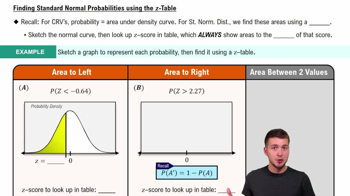
Finding Standard Normal Probabilities using z-Table

Central Limit Theorem

The Central Limit Theorem states that the sampling distribution of the sample mean will be normally distributed, regardless of the shape of the population distribution, provided the sample size is sufficiently large (typically n ≥ 30). In this case, since we are dealing with a sample of 4 adults, we can still apply the theorem to approximate the distribution of the sample mean, allowing us to calculate the probability of their mean score being at least 131.
추천 영상:
04:52
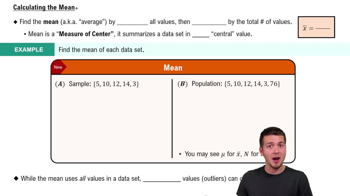
Calculating the Mean

Z-Score

A Z-score is a statistical measurement that describes a value's relationship to the mean of a group of values, expressed in terms of standard deviations from the mean. To find the probability that the mean score of the 4 adults is at least 131, we first calculate the Z-score for 131 using the formula Z = (X - μ) / (σ/√n), where X is the score of interest, μ is the mean, σ is the standard deviation, and n is the sample size.
추천 영상:
06:31
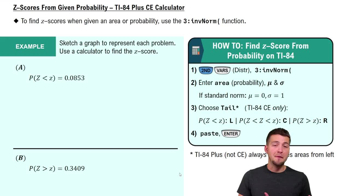
Z-Scores From Given Probability - TI-84 (CE) Calculator
관련 실천
교과서 질문

In Exercises 1 and 2, use the following wait times (minutes) at 10:00 AM for the Tower of Terror ride at Disney World (from Data Set 33 “Disney World Wait Times” in Appendix B).


35 35 20 50 95 75 45 50 30 35 30 30


d. The accompanying normal quantile plot is obtained by using all 50 wait times at 10:00 AM for the Tower of Terror ride at Disney World. Based on this normal quantile plot, do the sample data appear to be from a normally distributed population?

147
views
교과서 질문

Bone Density Test A bone mineral density test is used to identify a bone disease. The result of a bone density test is commonly measured as a z score, and the population of z scores is normally distributed with a mean of 0 and a standard deviation of 1.

e. If the mean bone density test score is found for 9 randomly selected subjects, find the probability that the mean is greater than 0.23.

179
views
교과서 질문

Blue Eyes Assume that 35% of us have blue eyes (based on a study by Dr. P. Soria at Indiana University).


c. Find the probability of randomly selecting three different people and finding that all of them have blue eyes.

130
views
교과서 질문

In Exercises 8 and 9, assume that women have standing eye heights that are normally distributed with a mean of 59.7 in. and a standard deviation of 2.5 in. (based on anthropometric survey data from Gordon, Churchill, et al.).


Significance Instead of using 0.05 for identifying significant values, use the criteria that a value x is significantly high if P(x or greater) ≤ 0.01 and a value is significantly low if P(x or less) ≤ 0.01. Find the standing eye heights of women that separate significant values from those that are not significant. Using these criteria, is a woman’s standing eye height of 67 in. significantly high?

104
views
교과서 질문

In Exercises 1 and 2, use the following wait times (minutes) at 10:00 AM for the Tower of Terror ride at Disney World (from Data Set 33 “Disney World Wait Times” in Appendix B).


35 35 20 50 95 75 45 50 30 35 30 30


e. Convert the longest wait time to a z score.

f. Based on the result from part (e), is the longest wait time significantly high?

112
views
교과서 질문

Mensa Membership in Mensa requires a score in the top 2% on a standard intelligence test. The Wechsler IQ test is designed for a mean of 100 and a standard deviation of 15, and scores are normally distributed.


a. Find the minimum Wechsler IQ test score that satisfies the Mensa requirement.

481
views