
Ch. 6 - Normal Probability Distributions
Triola - Elementary Statistics 14th Edition
Triola14th EditionElementary StatisticsISBN: 9780137366446당신이 사용하는 게 아니라요?교과서 변경
6장, 문제 6.R.9

In Exercises 8 and 9, assume that women have standing eye heights that are normally distributed with a mean of 59.7 in. and a standard deviation of 2.5 in. (based on anthropometric survey data from Gordon, Churchill, et al.).


Significance Instead of using 0.05 for identifying significant values, use the criteria that a value x is significantly high if P(x or greater) ≤ 0.01 and a value is significantly low if P(x or less) ≤ 0.01. Find the standing eye heights of women that separate significant values from those that are not significant. Using these criteria, is a woman’s standing eye height of 67 in. significantly high?

검증된 단계별 안내
1
Step 1: Understand the problem. We are tasked with finding the standing eye heights that separate significant values from those that are not significant, based on the given criteria. Specifically, a value is significantly high if P(x or greater) ≤ 0.01, and significantly low if P(x or less) ≤ 0.01. Additionally, we need to determine if a standing eye height of 67 inches is significantly high.
Step 2: Recall the properties of the normal distribution. The problem states that the standing eye heights are normally distributed with a mean (μ) of 59.7 inches and a standard deviation (σ) of 2.5 inches. To find the critical values, we will use the z-score formula: z = (x - μ) / σ.
Step 3: Find the z-scores corresponding to the cumulative probabilities of 0.01 and 0.99. For the significantly low threshold, we need the z-score where P(x or less) = 0.01. For the significantly high threshold, we need the z-score where P(x or greater) = 0.01, which corresponds to P(x or less) = 0.99 (since the total area under the curve is 1). Use a z-table or statistical software to find these z-scores.
Step 4: Convert the z-scores back to x-values (standing eye heights) using the formula x = μ + zσ. Substitute the mean (μ = 59.7) and standard deviation (σ = 2.5) into the formula along with the z-scores obtained in Step 3 to calculate the critical standing eye heights.
Step 5: Determine if a standing eye height of 67 inches is significantly high. Calculate the z-score for x = 67 using the formula z = (x - μ) / σ. Compare this z-score to the critical z-score for significantly high values (from Step 3). If the z-score for 67 inches is greater than or equal to the critical z-score, then 67 inches is significantly high.

비슷한 문제에 대한 검증된 영상 답변:

이 영상 해법은 위 문제에 도움이 된다고 튜터들이 추천한 것입니다.
영상 길이:
5m
도움이 되었나요?

주요 개념

질문에 올바르게 답하기 위해 반드시 이해해야 하는 핵심 개념들은 다음과 같습니다.

Normal Distribution

Normal distribution is a probability distribution that is symmetric about the mean, indicating that data near the mean are more frequent in occurrence than data far from the mean. It is characterized by its bell-shaped curve, defined by its mean and standard deviation. In this context, the standing eye heights of women are assumed to follow a normal distribution, which allows for the application of statistical methods to determine significance.
추천 영상:
09:47
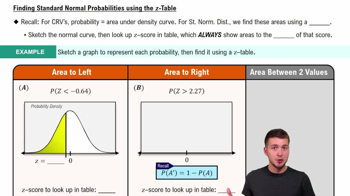
Finding Standard Normal Probabilities using z-Table

Z-Score

A Z-score measures how many standard deviations an element is from the mean. It is calculated by subtracting the mean from the value and then dividing by the standard deviation. In this question, calculating the Z-score for a standing eye height of 67 inches will help determine whether it falls within the significant range defined by the criteria of P(x or greater) ≤ 0.01.
추천 영상:
06:31
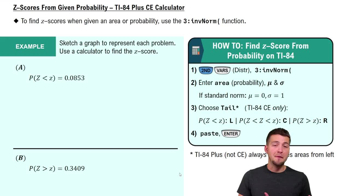
Z-Scores From Given Probability - TI-84 (CE) Calculator

Significance Level

The significance level, often denoted as alpha (α), is the threshold used to determine whether a result is statistically significant. In this case, the criteria specify that a value is significantly high if the probability of observing that value or greater is less than or equal to 0.01. This means that only the most extreme values in the distribution will be considered significantly high, allowing for a more stringent test of significance.
추천 영상:
04:46
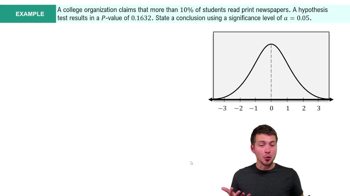
Step 4: State Conclusion Example 4
관련 실천
교과서 질문

In Exercises 8 and 9, assume that women have standing eye heights that are normally distributed with a mean of 59.7 in. and a standard deviation of 2.5 in. (based on anthropometric survey data from Gordon, Churchill, et al.).

a. If an eye recognition security system is positioned at a height that is uncomfortable for women with standing eye heights less than 54 in., what percentage of women will find that height uncomfortable?

106
views
교과서 질문

Bone Density Test A bone mineral density test is used to identify a bone disease. The result of a bone density test is commonly measured as a z score, and the population of z scores is normally distributed with a mean of 0 and a standard deviation of 1.

e. If the mean bone density test score is found for 9 randomly selected subjects, find the probability that the mean is greater than 0.23.

179
views
교과서 질문

Mensa Membership in Mensa requires a score in the top 2% on a standard intelligence test. The Wechsler IQ test is designed for a mean of 100 and a standard deviation of 15, and scores are normally distributed.


b. If 4 randomly selected adults take the Wechsler IQ test, find the probability that their mean score is at least 131.

233
views
교과서 질문

Blue Eyes Assume that 35% of us have blue eyes (based on a study by Dr. P. Soria at Indiana University).


c. Find the probability of randomly selecting three different people and finding that all of them have blue eyes.

130
views
교과서 질문

Birth Weights Based on Data Set 6 “Births” in Appendix B, birth weights of girls are normally distributed with a mean of 3037.1 g and a standard deviation of 706.3 g.


b. What is the value of the median?

107
views
교과서 질문

Mensa Membership in Mensa requires a score in the top 2% on a standard intelligence test. The Wechsler IQ test is designed for a mean of 100 and a standard deviation of 15, and scores are normally distributed.


a. Find the minimum Wechsler IQ test score that satisfies the Mensa requirement.

481
views