
Ch. 7 - Estimating Parameters and Determining Sample Sizes
Triola - Elementary Statistics 14th Edition
Triola14th EditionElementary StatisticsISBN: 9780137366446당신이 사용하는 게 아니라요?교과서 변경
7장, 문제 7.1.21c

Critical Thinking. In Exercises 17–28, use the data and confidence level to construct a confidence interval estimate of p, then address the given question.


Touch Therapy When she was 9 years of age, Emily Rosa did a science fair experiment in which she tested professional touch therapists to see if they could sense her energy field. She flipped a coin to select either her right hand or her left hand, and then she asked the therapists to identify the selected hand by placing their hand just under Emily’s hand without seeing it and without touching it. Among 280 trials, the touch therapists were correct 123 times (based on data in “A Close Look at Therapeutic Touch,” Journal of the American Medical Association, Vol. 279, No. 13).


c. Using Emily’s sample results, construct a 99% confidence interval estimate of the proportion of correct responses made by touch therapists.

검증된 단계별 안내
1
Step 1: Identify the sample proportion (p̂) using the formula p̂ = x / n, where x is the number of correct responses (123) and n is the total number of trials (280). This gives the proportion of correct responses observed in the sample.
Step 2: Determine the standard error (SE) of the sample proportion using the formula SE = sqrt((p̂ * (1 - p̂)) / n). This measures the variability of the sample proportion.
Step 3: Find the critical value (z) for a 99% confidence level. For a 99% confidence interval, the z-value corresponds to the area under the standard normal curve, which is approximately 2.576.
Step 4: Calculate the margin of error (ME) using the formula ME = z * SE. This represents the range of error around the sample proportion.
Step 5: Construct the confidence interval for the population proportion (p) using the formula: Confidence Interval = p̂ ± ME. This provides the range within which the true proportion of correct responses is likely to fall with 99% confidence.

비슷한 문제에 대한 검증된 영상 답변:

이 영상 해법은 위 문제에 도움이 된다고 튜터들이 추천한 것입니다.
영상 길이:
2m
도움이 되었나요?

주요 개념

질문에 올바르게 답하기 위해 반드시 이해해야 하는 핵심 개념들은 다음과 같습니다.

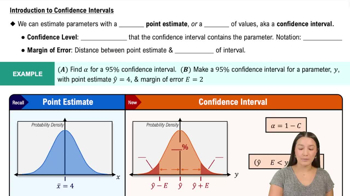
Confidence Interval

A confidence interval is a range of values, derived from sample statistics, that is likely to contain the true population parameter with a specified level of confidence. For example, a 99% confidence interval suggests that if the same sampling method were repeated multiple times, approximately 99% of the calculated intervals would contain the true proportion. This concept is crucial for estimating the reliability of sample data in making inferences about a larger population.
추천 영상:
가이드 코스
06:33
Introduction to Confidence Intervals

Proportion

In statistics, a proportion is a type of ratio that represents the part of a whole. It is calculated by dividing the number of successful outcomes by the total number of trials. In the context of Emily Rosa's experiment, the proportion of correct responses by touch therapists is determined by dividing the number of correct identifications (123) by the total trials (280), providing insight into their performance relative to chance.
추천 영상:
가이드 코스
09:27
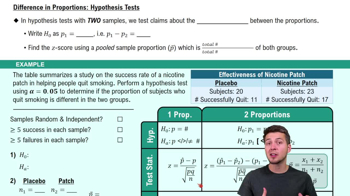
Difference in Proportions: Hypothesis Tests

Sample Size

Sample size refers to the number of observations or trials included in a statistical sample. A larger sample size generally leads to more reliable estimates and narrower confidence intervals, as it reduces the margin of error. In Emily's study, the sample size of 280 trials is significant, as it allows for a more accurate estimation of the proportion of correct responses and enhances the validity of the confidence interval constructed.
추천 영상:
가이드 코스
05:11
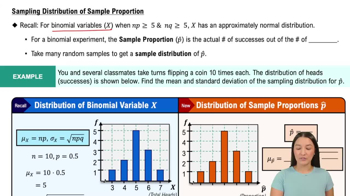
Sampling Distribution of Sample Proportion
관련 실천
교과서 질문

E-Cigarettes A New York Times article reported that a survey conducted in 2014 included 36,000 adults, with 3.7% of them being regular users of e-cigarettes. Because e-cigarette use is relatively new, there is a need to obtain today’s usage rate. How many adults must be surveyed now if we want a confidence level of 95% and a margin of error of 1.5 percentage points?


c. Does the use of the result from the 2014 survey have much of an effect on the sample size?

139
views
교과서 질문

Smart Phone Apple is planning for the launch of a new and improved iPhone. The marketing team wants to know the worldwide percentage of consumers who intend to purchase the new model, so a survey is being planned. How many people must be surveyed in order to be 90% confident that the estimated percentage is within three percentage points of the true population percentage?


c. Given that the required sample size is relatively small, could you simply survey the people that you know?

105
views
교과서 질문

Tour de France Listed below are the average speeds (km/h) of winners of the Tour de France men’s bicycle race. The speeds are listed in order by year, beginning with the year 2000.


a. Construct a 95% confidence interval estimate of the population mean.


79
views
교과서 질문

Touch Your Nose With Your Tongue Find the sample size needed to estimate the percentage of adults who can touch their nose with their tongue. Use a margin of error of 2 percentage points and use a confidence level of 90%.


b. Assume that a previous study showed that 10% of adults can touch their nose with their tongue (based on data from Onedio).


121
views
교과서 질문

Critical Thinking. In Exercises 17–28, use the data and confidence level to construct a confidence interval estimate of p, then address the given question.


Job Interviews In a Harris poll of 514 human resource professionals, 45.9% said that body piercings and tattoos were big personal grooming red flags.


c. Repeat part (b) using a confidence level of 80%.


125
views
교과서 질문

Women Who Give Birth An epidemiologist plans to conduct a survey to estimate the percentage of women who give birth. How many women must be surveyed in order to be 99% confident that the estimated percentage is in error by no more than two percentage points?


c. What is wrong with surveying randomly selected adult women?

138
views