
Ch. 7 - Estimating Parameters and Determining Sample Sizes
Triola - Elementary Statistics 14th Edition
Triola14th EditionElementary StatisticsISBN: 9780137366446당신이 사용하는 게 아니라요?교과서 변경
7장, 문제 7.1.37c

Smart Phone Apple is planning for the launch of a new and improved iPhone. The marketing team wants to know the worldwide percentage of consumers who intend to purchase the new model, so a survey is being planned. How many people must be surveyed in order to be 90% confident that the estimated percentage is within three percentage points of the true population percentage?


c. Given that the required sample size is relatively small, could you simply survey the people that you know?

검증된 단계별 안내
1
Step 1: Identify the formula for determining the required sample size for estimating a population proportion. The formula is: n = (z² × p × (1 - p)) / E², where n is the sample size, z is the z-score corresponding to the confidence level, p is the estimated proportion, and E is the margin of error.
Step 2: Determine the values for the variables in the formula. For a 90% confidence level, the z-score is approximately 1.645. The margin of error (E) is given as 0.03 (three percentage points). Since the estimated proportion (p) is not provided, use 0.5 as a conservative estimate to maximize the required sample size.
Step 3: Substitute the values into the formula. Replace z with 1.645, p with 0.5, and E with 0.03 in the formula: n = (1.645² × 0.5 × (1 - 0.5)) / 0.03².
Step 4: Simplify the formula step by step. First, calculate 1.645², then multiply it by 0.5 × (1 - 0.5), and finally divide the result by 0.03². This will give the required sample size.
Step 5: Address the second part of the question. Surveying only the people you know would introduce bias into the sample, as it would not be representative of the worldwide population. A random sampling method should be used to ensure the results are generalizable to the entire population.

비슷한 문제에 대한 검증된 영상 답변:

이 영상 해법은 위 문제에 도움이 된다고 튜터들이 추천한 것입니다.
영상 길이:
3m
도움이 되었나요?

주요 개념

질문에 올바르게 답하기 위해 반드시 이해해야 하는 핵심 개념들은 다음과 같습니다.

Sample Size Determination

Sample size determination is a statistical process used to calculate the number of observations or replicates needed in a survey to achieve a desired level of confidence and precision. In this case, the marketing team needs to determine how many consumers to survey to ensure that the estimated percentage of those intending to purchase the new iPhone is accurate within three percentage points, with 90% confidence.
추천 영상:
가이드 코스
05:11
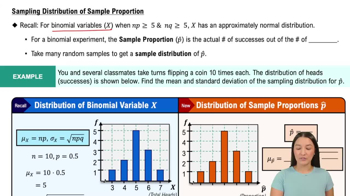
Sampling Distribution of Sample Proportion

Confidence Level

The confidence level represents the degree of certainty that the sample accurately reflects the population. A 90% confidence level means that if the survey were repeated multiple times, 90% of the time the results would fall within the specified margin of error. This concept is crucial for understanding how reliable the survey results will be in predicting consumer behavior.
추천 영상:
가이드 코스
06:33
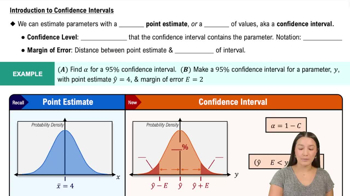
Introduction to Confidence Intervals

Margin of Error

Margin of error is a statistic that expresses the amount of random sampling error in a survey's results. It indicates the range within which the true population parameter is expected to lie, based on the sample data. In this scenario, a margin of error of three percentage points means that the actual percentage of consumers intending to purchase the new iPhone could be three points higher or lower than the survey estimate.
추천 영상:
가이드 코스
04:08
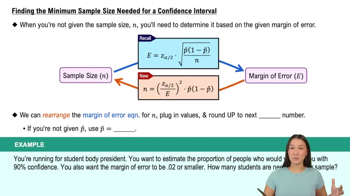
Finding the Minimum Sample Size Needed for a Confidence Interval
관련 실천
교과서 질문

E-Cigarettes A New York Times article reported that a survey conducted in 2014 included 36,000 adults, with 3.7% of them being regular users of e-cigarettes. Because e-cigarette use is relatively new, there is a need to obtain today’s usage rate. How many adults must be surveyed now if we want a confidence level of 95% and a margin of error of 1.5 percentage points?


c. Does the use of the result from the 2014 survey have much of an effect on the sample size?

139
views
교과서 질문

Voting Survey In a survey of 1002 people, 70% said that they voted in a recent presidential election (based on data from ICR Research Group). Voting records show that 61% of eligible voters actually did vote.


d. Are the survey results consistent with the actual voter turnout of 61%? Why or why not?

97
views
교과서 질문

Tour de France Listed below are the average speeds (km/h) of winners of the Tour de France men’s bicycle race. The speeds are listed in order by year, beginning with the year 2000.


a. Construct a 95% confidence interval estimate of the population mean.


79
views
교과서 질문

Critical Thinking. In Exercises 17–28, use the data and confidence level to construct a confidence interval estimate of p, then address the given question.


Touch Therapy When she was 9 years of age, Emily Rosa did a science fair experiment in which she tested professional touch therapists to see if they could sense her energy field. She flipped a coin to select either her right hand or her left hand, and then she asked the therapists to identify the selected hand by placing their hand just under Emily’s hand without seeing it and without touching it. Among 280 trials, the touch therapists were correct 123 times (based on data in “A Close Look at Therapeutic Touch,” Journal of the American Medical Association, Vol. 279, No. 13).


c. Using Emily’s sample results, construct a 99% confidence interval estimate of the proportion of correct responses made by touch therapists.


142
views
교과서 질문

Alcohol in Children’s Movies Listed below is a simple random sample of times (seconds) that animated children’s movies showed the use of alcohol (based on Data Set 20 “Alcohol and Tobacco in Movies” in Appendix B).


a. Are the requirements for constructing a 95% confidence interval estimate of the population mean satisfied? If so, construct that confidence interval.


96
views
교과서 질문

Women Who Give Birth An epidemiologist plans to conduct a survey to estimate the percentage of women who give birth. How many women must be surveyed in order to be 99% confident that the estimated percentage is in error by no more than two percentage points?


c. What is wrong with surveying randomly selected adult women?

138
views