In Exercises 55–58, use a calculator to find the value of the acute angle θ to the nearest degree. sin θ = 0.2974
Ch. 1 - Angles and the Trigonometric Functions

1장, 문제 1
In Exercises 1–8, use the Pythagorean Theorem to find the length of the missing side of each right triangle. Then find the value of each of the six trigonometric functions of θ.

검증된 단계별 안내1
Identify the sides of the right triangle relative to angle \( \theta \) at vertex Q: the side opposite \( \theta \) is \( 3 \), the side adjacent to \( \theta \) is \( 4 \), and the hypotenuse \( PQ \) is unknown.
Use the Pythagorean Theorem to find the hypotenuse \( PQ \): \( PQ^2 = QR^2 + PR^2 \), which translates to \( PQ^2 = 4^2 + 3^2 \).
Calculate \( PQ \) by taking the square root of the sum: \( PQ = \sqrt{4^2 + 3^2} \). This gives the length of the hypotenuse.
Find the six trigonometric functions of \( \theta \) using the side lengths:
- Sine: \( \sin \theta = \frac{\text{opposite}}{\text{hypotenuse}} = \frac{3}{PQ} \)
- Cosine: \( \cos \theta = \frac{\text{adjacent}}{\text{hypotenuse}} = \frac{4}{PQ} \)
- Tangent: \( \tan \theta = \frac{\text{opposite}}{\text{adjacent}} = \frac{3}{4} \)
Use the reciprocal identities to find the remaining three functions:
- Cosecant: \( \csc \theta = \frac{1}{\sin \theta} = \frac{PQ}{3} \)
- Secant: \( \sec \theta = \frac{1}{\cos \theta} = \frac{PQ}{4} \)
- Cotangent: \( \cot \theta = \frac{1}{\tan \theta} = \frac{4}{3} \)

비슷한 문제에 대한 검증된 영상 답변:
이 영상 해법은 위 문제에 도움이 된다고 튜터들이 추천한 것입니다.
영상 길이:
4m도움이 되었나요?
주요 개념
질문에 올바르게 답하기 위해 반드시 이해해야 하는 핵심 개념들은 다음과 같습니다.
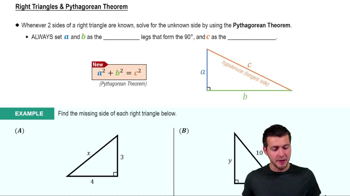
Pythagorean Theorem
The Pythagorean Theorem states that in a right triangle, the square of the hypotenuse (the side opposite the right angle) equals the sum of the squares of the other two sides. It is expressed as a² + b² = c². This theorem is essential for finding the missing side length when two sides are known.
추천 영상:
Solving Right Triangles with the Pythagorean Theorem
Right Triangle Trigonometric Functions
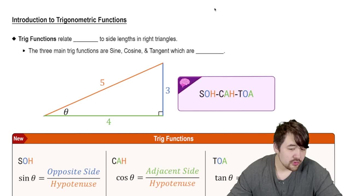
The six trigonometric functions (sine, cosine, tangent, cosecant, secant, and cotangent) relate the angles of a right triangle to the ratios of its sides. For an angle θ, sine is opposite/hypotenuse, cosine is adjacent/hypotenuse, and tangent is opposite/adjacent. The reciprocal functions are cosecant, secant, and cotangent.
추천 영상:
Introduction to Trigonometric Functions
Identifying Sides Relative to an Angle
In a right triangle, the sides are classified relative to the angle of interest: the opposite side is across from the angle, the adjacent side is next to the angle (but not the hypotenuse), and the hypotenuse is the longest side opposite the right angle. Correctly identifying these sides is crucial for applying trigonometric functions.
추천 영상:
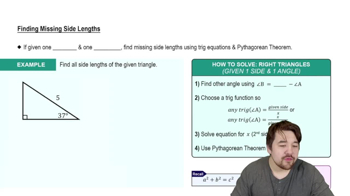
Finding Missing Side Lengths
관련 실천
교과서 질문
685
views
교과서 질문
In Exercises 57–70, find a positive angle less than or that is coterminal with the given angle. -150°
563
views
교과서 질문
In Exercises 55–58, use a calculator to find the value of the acute angle θ to the nearest degree. tan θ = 4.6252
630
views
교과서 질문
In Exercises 63–68, find the exact value of each expression. Do not use a calculator. csc 37° sec 53° - tan 53° cot 37°
595
views
교과서 질문
In Exercises 1–6, the measure of an angle is given. Classify the angle as acute, right, obtuse, or straight. 135°
807
views
교과서 질문
In Exercises 75–78, find the area of the sector of a circle of radius r formed by a central angle θ. Express area in terms of π. Then round your answer to two decimal places. Radius, r: 10 meters Central Angle, θ: θ = 18°
576
views