
교과서 질문
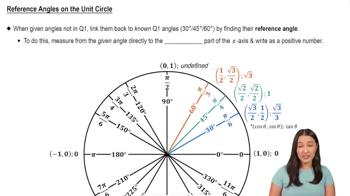
A point P(x, y) is shown on the unit circle corresponding to a real number t. Find the values of the trigonometric functions at t.
<IMAGE>
487
views

 검증된 단계별 안내
 5:31
5:31
 6:36
6:36 7:28
7:28A point P(x, y) is shown on the unit circle corresponding to a real number t. Find the values of the trigonometric functions at t.
<IMAGE>
In Exercises 49–59, find the exact value of each expression. Do not use a calculator. sin(-𝜋/3)
In Exercises 41–56, use the circle shown in the rectangular coordinate system to draw each angle in standard position. State the quadrant in which the angle lies. When an angle's measure is given in radians, work the exercise without converting to degrees.
420°
In Exercises 1–8, use the Pythagorean Theorem to find the length of the missing side of each right triangle. Then find the value of each of the six trigonometric functions of θ.
In Exercises 1–6, the measure of an angle is given. Classify the angle as acute, right, obtuse, or straight. 135°
In Exercises 61–86, use reference angles to find the exact value of each expression. Do not use a calculator. tan(9𝜋/2)