In Exercises 63–82, use a sketch to find the exact value of each expression. cos (sin⁻¹ 4/5)
Ch. 2 - Graphs of the Trigonometric Functions; Inverse Trigonometric Functions

모든 교과서
Blitzer 3rd Edition
Ch. 2 - Graphs of the Trigonometric Functions; Inverse Trigonometric Functions
문제 64
Blitzer 3rd Edition
Ch. 2 - Graphs of the Trigonometric Functions; Inverse Trigonometric Functions
문제 642장, 문제 64
In Exercises 61–66, use the method of adding y-coordinates to graph each function for 0 ≤ x ≤ 2π. y = cos x + cos 2x
검증된 단계별 안내1
Identify the two functions involved: \(y_1 = \cos x\) and \(y_2 = \cos 2x\). We will graph each separately first for \(0 \leq x \leq 2\pi\).
Create a table of values for \(y_1 = \cos x\) by choosing several \(x\) values between \(0\) and \(2\pi\) (for example, \(0\), \(\frac{\pi}{2}\), \(\pi\), \(\frac{3\pi}{2}\), \(2\pi\)) and calculate the corresponding \(y_1\) values.
Similarly, create a table of values for \(y_2 = \cos 2x\) using the same \(x\) values, noting that the frequency is doubled, so the function completes two full cycles between \(0\) and \(2\pi\).
For each \(x\) value, add the corresponding \(y\)-coordinates from \(y_1\) and \(y_2\) to find the combined function value: \(y = \cos x + \cos 2x\).
Plot the points \((x, y)\) on the coordinate plane and connect them smoothly to graph the function \(y = \cos x + \cos 2x\) over the interval \(0 \leq x \leq 2\pi\).

비슷한 문제에 대한 검증된 영상 답변:
이 영상 해법은 위 문제에 도움이 된다고 튜터들이 추천한 것입니다.
영상 길이:
8m도움이 되었나요?
주요 개념
질문에 올바르게 답하기 위해 반드시 이해해야 하는 핵심 개념들은 다음과 같습니다.
Graphing Trigonometric Functions
Graphing trigonometric functions involves plotting points based on their values at various angles, typically measured in radians. Understanding the shape, period, amplitude, and phase shift of functions like cosine helps visualize their behavior over an interval such as 0 to 2π.
추천 영상:
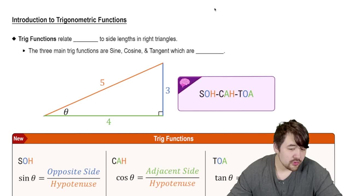
Introduction to Trigonometric Functions
Sum of Trigonometric Functions
When adding two trigonometric functions, the resulting graph is found by adding their y-coordinates point-by-point. This method combines the individual waveforms, producing a new function that reflects the superposition of the original functions' oscillations.
추천 영상:
Introduction to Trigonometric Functions
Period and Frequency of Cosine Functions
The period of a cosine function y = cos(kx) is given by 2π/k, indicating how often the function repeats. For y = cos x and y = cos 2x, their periods differ, affecting how their graphs combine when added, which is essential for accurately plotting the sum over 0 ≤ x ≤ 2π.
추천 영상:
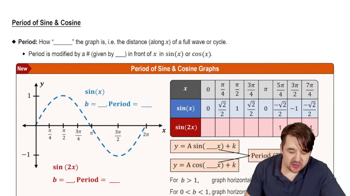
Period of Sine and Cosine Functions
관련 실천
교과서 질문
658
views
교과서 질문
In Exercises 61–62, use the figures shown to find the bearing from O to A.
1054
views
교과서 질문
In Exercises 61–66, use the method of adding y-coordinates to graph each function for 0 ≤ x ≤ 2π. y = cos x + sin 2x
687
views
교과서 질문
In Exercises 61–66, use the method of adding y-coordinates to graph each function for 0 ≤ x ≤ 2π. y = 3 cos x + sin x
615
views
교과서 질문
In Exercises 65–66, an object moves in simple harmonic motion described by the given equation, where t is measured in seconds and d in centimeters. In each exercise, find: a. the maximum displacement b. the frequency c. the time required for one cycle. d = 20 cos π/4 t
800
views
교과서 질문
In Exercises 63–82, use a sketch to find the exact value of each expression. tan (cos⁻¹ 5/13)
716
views