Ch. 2 - Graphs of the Trigonometric Functions; Inverse Trigonometric Functions
Blitzer - Trigonometry 3rd Edition
Blitzer3rd EditionTrigonometryISBN: 9780137316601당신이 사용하는 게 아니라요?교과서 변경
2장, 문제 77

In Exercises 63–82, use a sketch to find the exact value of each expression. cos [tan⁻¹ (− 2/3)]

검증된 단계별 안내
1
Recognize that the expression involves the cosine of an inverse tangent function: \(\cos\left(\tan^{-1}\left(-\frac{2}{3}\right)\right)\). This means we need to find the cosine of an angle whose tangent is \(-\frac{2}{3}\).
Let \(\theta = \tan^{-1}\left(-\frac{2}{3}\right)\). By definition, \(\tan(\theta) = -\frac{2}{3}\). We can think of \(\theta\) as an angle in a right triangle where the opposite side is \(-2\) and the adjacent side is \(3\) (the negative sign indicates direction, which affects the quadrant).
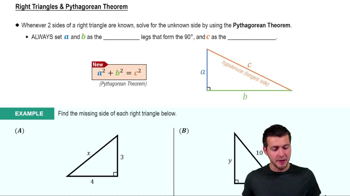
Use the Pythagorean theorem to find the hypotenuse \(r\) of the triangle: \(r = \sqrt{(3)^2 + (-2)^2} = \sqrt{9 + 4} = \sqrt{13}\).
Recall that \(\cos(\theta) = \frac{\text{adjacent}}{\text{hypotenuse}}\). Using the triangle sides, \(\cos(\theta) = \frac{3}{\sqrt{13}}\). Consider the sign of cosine based on the quadrant of \(\theta\) (since tangent is negative, \(\theta\) lies in either the second or fourth quadrant).
Determine the correct sign of \(\cos(\theta)\) based on the quadrant and write the exact value of \(\cos\left(\tan^{-1}\left(-\frac{2}{3}\right)\right)\) as \(\pm \frac{3}{\sqrt{13}}\) accordingly.

비슷한 문제에 대한 검증된 영상 답변:

이 영상 해법은 위 문제에 도움이 된다고 튜터들이 추천한 것입니다.
영상 길이:
3m
도움이 되었나요?

주요 개념

질문에 올바르게 답하기 위해 반드시 이해해야 하는 핵심 개념들은 다음과 같습니다.

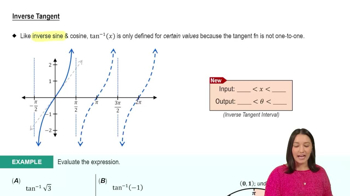
Inverse Tangent Function (tan⁻¹ or arctan)

The inverse tangent function returns the angle whose tangent is a given number. For tan⁻¹(−2/3), it gives an angle in the range of −π/2 to π/2 whose tangent is −2/3. Understanding this helps in interpreting the angle involved in the problem.
추천 영상:
3:17
Inverse Tangent

Right Triangle Representation of Trigonometric Ratios

Trigonometric functions can be represented using right triangles, where the sides correspond to ratios like opposite, adjacent, and hypotenuse. For tan⁻¹(−2/3), a triangle with opposite side −2 and adjacent side 3 can be sketched to find the hypotenuse and then calculate cosine.
추천 영상:
5:19
Solving Right Triangles with the Pythagorean Theorem

Relationship Between Tangent and Cosine

Cosine of an angle can be found using the sides of the right triangle: cos(θ) = adjacent/hypotenuse. Given tan(θ) = opposite/adjacent, once the hypotenuse is found using the Pythagorean theorem, cosine can be calculated exactly.
추천 영상:
5:08
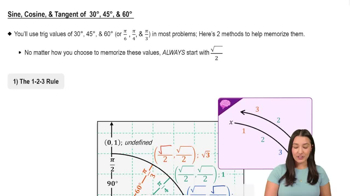
Sine, Cosine, & Tangent of 30°, 45°, & 60°