In Exercises 63–82, use a sketch to find the exact value of each expression. cot (csc⁻¹ 8)
Ch. 2 - Graphs of the Trigonometric Functions; Inverse Trigonometric Functions

모든 교과서
Blitzer 3rd Edition
Ch. 2 - Graphs of the Trigonometric Functions; Inverse Trigonometric Functions
문제 80
Blitzer 3rd Edition
Ch. 2 - Graphs of the Trigonometric Functions; Inverse Trigonometric Functions
문제 802장, 문제 80
In Exercises 79–82, graph f, g, and h in the same rectangular coordinate system for 0 ≤ x ≤ 2π. Obtain the graph of h by adding or subtracting the corresponding y-coordinates on the graphs of f and g. f(x) = 2 cos x, g(x) = cos 2x, h(x) = (f + g)(x)
검증된 단계별 안내1
Identify the given functions: \(f(x) = 2 \cos x\), \(g(x) = \cos 2x\), and \(h(x) = (f + g)(x) = f(x) + g(x)\).
Understand that to graph \(h(x)\), you need to add the corresponding \(y\)-values of \(f(x)\) and \(g(x)\) for each \(x\) in the interval \(0 \leq x \leq 2\pi\).
Create a table of values for \(x\) at key points within \(0\) to \(2\pi\) (such as \(0\), \(\frac{\pi}{2}\), \(\pi\), \(\frac{3\pi}{2}\), and \(2\pi\)). Calculate \(f(x)\) and \(g(x)\) at each of these points.
Add the values from \(f(x)\) and \(g(x)\) at each \(x\) to find \(h(x)\), i.e., compute \(h(x) = 2 \cos x + \cos 2x\) for each \(x\).
Plot the points for \(f(x)\), \(g(x)\), and \(h(x)\) on the same coordinate system and draw smooth curves through these points to visualize how \(h(x)\) is formed by adding the graphs of \(f\) and \(g\).

비슷한 문제에 대한 검증된 영상 답변:
이 영상 해법은 위 문제에 도움이 된다고 튜터들이 추천한 것입니다.
영상 길이:
6m도움이 되었나요?
주요 개념
질문에 올바르게 답하기 위해 반드시 이해해야 하는 핵심 개념들은 다음과 같습니다.
Graphing Trigonometric Functions
Graphing trigonometric functions involves plotting their values over a specified domain, such as 0 to 2π. Understanding the shape, period, amplitude, and phase shift of functions like cosine helps visualize their behavior and compare multiple functions on the same coordinate system.
추천 영상:
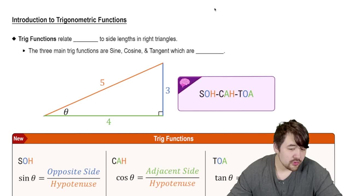
Introduction to Trigonometric Functions
Function Addition and Pointwise Operations
Adding functions means combining their outputs for each input value. For h(x) = f(x) + g(x), the y-coordinate of h at any x is the sum of the y-coordinates of f and g at that x. This concept is essential for constructing the graph of h from f and g.
추천 영상:
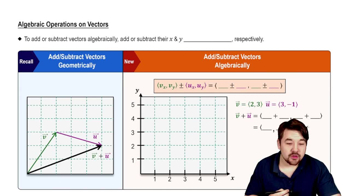
Algebraic Operations on Vectors
Properties of Cosine Functions and Frequency
Cosine functions like cos x and cos 2x differ in frequency; cos 2x completes two cycles in the interval 0 to 2π, while cos x completes one. Recognizing how frequency affects the graph's oscillations is crucial for accurately plotting and combining these functions.
추천 영상:
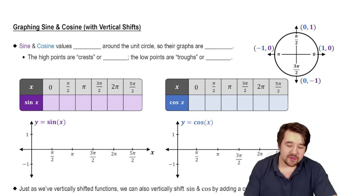
Graph of Sine and Cosine Function
관련 실천
교과서 질문
688
views
교과서 질문
In Exercises 63–82, use a sketch to find the exact value of each expression. cos [tan⁻¹ (− 2/3)]
660
views
교과서 질문
In Exercises 75–78, graph one period of each function. y = |2 cos x/2|
558
views
교과서 질문
In Exercises 79–82, graph f, g, and h in the same rectangular coordinate system for 0 ≤ x ≤ 2π. Obtain the graph of h by adding or subtracting the corresponding y-coordinates on the graphs of f and g. f(x) = cos x, g(x) = sin 2x, h(x) = (f − g)(x)
657
views
교과서 질문
In Exercises 75–78, graph one period of each function. y = −|3 sin πx|
536
views
교과서 질문
In Exercises 83–94, use a right triangle to write each expression as an algebraic expression. Assume that x is positive and that the given inverse trigonometric function is defined for the expression in x. tan (cos⁻¹ x)
836
views
1
comments