In Exercises 63–82, use a sketch to find the exact value of each expression. tan [cos⁻¹ (− 1/3)]
Ch. 2 - Graphs of the Trigonometric Functions; Inverse Trigonometric Functions

모든 교과서
Blitzer 3rd Edition
Ch. 2 - Graphs of the Trigonometric Functions; Inverse Trigonometric Functions
문제 68
Blitzer 3rd Edition
Ch. 2 - Graphs of the Trigonometric Functions; Inverse Trigonometric Functions
문제 682장, 문제 68
In Exercises 67–68, an object is attached to a coiled spring. In Exercise 67, the object is pulled down (negative direction from the rest position) and then released. In Exercise 68, the object is propelled downward from its rest position. Write an equation for the distance of the object from its rest position after t seconds.
검증된 단계별 안내1
Identify the type of motion described: since the object is attached to a coiled spring and moves up and down, this is simple harmonic motion, which can be modeled using sine or cosine functions.
Define the variables: let \(x(t)\) represent the distance from the rest position at time \(t\), \(A\) be the amplitude (maximum displacement), \(\omega\) be the angular frequency (related to the spring constant and mass), and \(\phi\) be the phase shift (which depends on initial conditions).
Write the general form of the equation for simple harmonic motion: \(x(t) = A \cos(\omega t + \phi)\) or \(x(t) = A \sin(\omega t + \phi)\).
For Exercise 67 (object pulled down and released), the initial displacement is maximum and velocity is zero, so use the cosine form with \(\phi = 0\), giving \(x(t) = -A \cos(\omega t)\) (negative because pulled down from rest).
For Exercise 68 (object propelled downward from rest position), the initial displacement is zero but initial velocity is downward, so use the sine form with appropriate phase shift, giving \(x(t) = -A \sin(\omega t)\).

비슷한 문제에 대한 검증된 영상 답변:
이 영상 해법은 위 문제에 도움이 된다고 튜터들이 추천한 것입니다.
영상 길이:
4m도움이 되었나요?
주요 개념
질문에 올바르게 답하기 위해 반드시 이해해야 하는 핵심 개념들은 다음과 같습니다.
Simple Harmonic Motion (SHM)
Simple Harmonic Motion describes oscillatory motion where the restoring force is proportional to displacement and acts in the opposite direction. For a mass-spring system, the motion is sinusoidal, and the position varies with time as a sine or cosine function, representing periodic movement about the rest position.
추천 영상:
Products of Complex Numbers in Polar Form
Trigonometric Functions in Oscillations
Sine and cosine functions model the displacement of oscillating objects over time. The choice between sine or cosine depends on initial conditions, such as starting position or velocity. These functions capture the periodic nature of the motion with parameters for amplitude, frequency, and phase shift.
추천 영상:
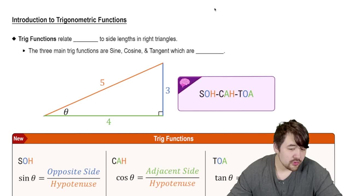
Introduction to Trigonometric Functions
Initial Conditions and Phase Shift
Initial conditions like initial displacement and velocity determine the phase shift and amplitude in the trigonometric equation of motion. For example, pulling the object down corresponds to a nonzero initial displacement, while propelling it downward from rest position corresponds to an initial velocity, affecting the form of the solution.
추천 영상:
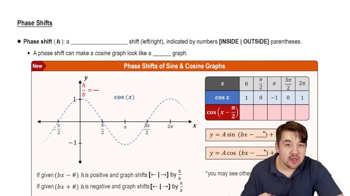
Phase Shifts
관련 실천
교과서 질문
853
views
교과서 질문
In Exercises 67–68, use the method of adding y-coordinates to graph each function for 0 ≤ x ≤ 4. y = cos πx + sin π/2 x
604
views
교과서 질문
In Exercises 63–82, use a sketch to find the exact value of each expression. _ sin (cos⁻¹ √2/2)
975
views
교과서 질문
In Exercises 63–82, use a sketch to find the exact value of each expression. tan [sin⁻¹ (− 3/5)]
697
views
교과서 질문
In Exercises 61–66, use the method of adding y-coordinates to graph each function for 0 ≤ x ≤ 2π. y = cos x + sin 2x
687
views
교과서 질문
In Exercises 65–66, an object moves in simple harmonic motion described by the given equation, where t is measured in seconds and d in centimeters. In each exercise, find: a. the maximum displacement b. the frequency c. the time required for one cycle. d = 20 cos π/4 t
800
views