교과서 질문
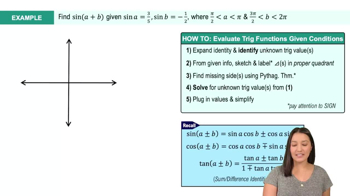
In Exercises 63–82, use a sketch to find the exact value of each expression. tan [cos⁻¹ (− 1/3)]
853
views

 Blitzer 3rd EditionCh. 2 - Graphs of the Trigonometric Functions; Inverse Trigonometric Functions문제 68
 검증된 단계별 안내
 6:04
6:04
 5:20
5:20 5:33
5:33In Exercises 63–82, use a sketch to find the exact value of each expression. tan [cos⁻¹ (− 1/3)]
In Exercises 63–82, use a sketch to find the exact value of each expression. _ sin (cos⁻¹ √2/2)
In Exercises 75–78, graph one period of each function. y = |2 cos x/2|
In Exercises 63–82, use a sketch to find the exact value of each expression. tan [sin⁻¹ (− 3/5)]
In Exercises 67–68, an object is attached to a coiled spring. In Exercise 67, the object is pulled down (negative direction from the rest position) and then released. In Exercise 68, the object is propelled downward from its rest position. Write an equation for the distance of the object from its rest position after t seconds.
In Exercises 61–66, use the method of adding y-coordinates to graph each function for 0 ≤ x ≤ 2π. y = cos x + sin 2x