Ch. 4 - Laws of Sines and Cosines; Vectors
Blitzer - Trigonometry 3rd Edition
Blitzer3rd EditionTrigonometryISBN: 9780137316601당신이 사용하는 게 아니라요?교과서 변경
4장, 문제 7

In Exercises 1–12, solve each triangle. Round lengths to the nearest tenth and angle measures to the nearest degree. If no triangle exists, state 'no triangle.' If two triangles exist, solve each triangle. C = 50°, a = 3, c = 1

검증된 단계별 안내
1
Identify the given elements of the triangle: angle \(C = 50^\circ\), side \(a = 3\), and side \(c = 1\). We need to solve the triangle, which means finding the remaining angles \(A\) and \(B\), and side \(b\).
Use the Law of Sines, which states: \(\frac{a}{\sin A} = \frac{c}{\sin C}\). Substitute the known values to set up the equation: \(\frac{3}{\sin A} = \frac{1}{\sin 50^\circ}\).
Solve for \(\sin A\) by cross-multiplying: \(\sin A = 3 \times \frac{\sin 50^\circ}{1} = 3 \sin 50^\circ\). Calculate \(3 \sin 50^\circ\) to check if it is less than or equal to 1, which determines if a triangle exists.
If \(\sin A\) is greater than 1, then no triangle exists. If \(\sin A\) is less than or equal to 1, find angle \(A\) by taking the inverse sine: \(A = \sin^{-1}(3 \sin 50^\circ)\). Remember that the sine function can have two possible angles in the range \(0^\circ\) to \(180^\circ\), so consider both possible values for \(A\) to check if two triangles exist.
Once you find the possible values for \(A\), calculate angle \(B\) using the triangle angle sum property: \(B = 180^\circ - A - C\). Then use the Law of Sines again to find side \(b\): \(\frac{b}{\sin B} = \frac{a}{\sin A}\). Round all lengths to the nearest tenth and angles to the nearest degree.

비슷한 문제에 대한 검증된 영상 답변:

이 영상 해법은 위 문제에 도움이 된다고 튜터들이 추천한 것입니다.
영상 길이:
3m
도움이 되었나요?

주요 개념

질문에 올바르게 답하기 위해 반드시 이해해야 하는 핵심 개념들은 다음과 같습니다.

Law of Sines

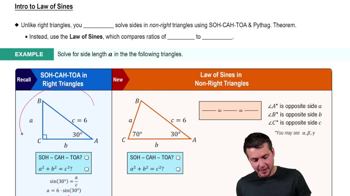
The Law of Sines relates the ratios of the lengths of sides of a triangle to the sines of their opposite angles. It is expressed as (a/sin A) = (b/sin B) = (c/sin C). This law is essential for solving triangles when given two sides and a non-included angle (SSA), as in this problem.
추천 영상:
가이드 코스
4:27
Intro to Law of Sines

Ambiguous Case of SSA Triangles

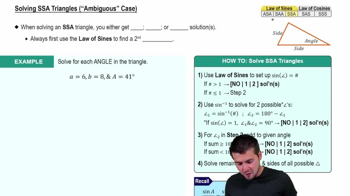
When given two sides and a non-included angle (SSA), there can be zero, one, or two possible triangles. This is known as the ambiguous case. Determining the number of solutions involves checking the height and comparing side lengths to decide if no triangle, one triangle, or two triangles exist.
추천 영상:
가이드 코스
9:50
Solving SSA Triangles ("Ambiguous" Case)

Triangle Angle Sum Property

The sum of the interior angles of any triangle is always 180°. After finding one or two unknown angles using the Law of Sines, this property helps calculate the remaining angle(s) to complete the triangle solution.
추천 영상:
4:47
Sum and Difference of Tangent