Ch. 4 - Laws of Sines and Cosines; Vectors
Blitzer - Trigonometry 3rd Edition
Blitzer3rd EditionTrigonometryISBN: 9780137316601당신이 사용하는 게 아니라요?교과서 변경
4장, 문제 8

In Exercises 1–12, solve each triangle. Round lengths to the nearest tenth and angle measures to the nearest degree. If no triangle exists, state 'no triangle.' If two triangles exist, solve each triangle. A = 162°, b = 11.2, c = 48.2

검증된 단계별 안내
1
Identify the given information: angle \(A = 162^\circ\), side \(b = 11.2\), and side \(c = 48.2\).
Use the Law of Sines to find another angle. The Law of Sines states: \(\frac{a}{\sin A} = \frac{b}{\sin B} = \frac{c}{\sin C}\). Start by finding angle \(B\) using \(\frac{b}{\sin B} = \frac{c}{\sin C}\).
Rearrange the equation to solve for \(\sin B\): \(\sin B = \frac{b \cdot \sin A}{c}\).
Calculate \(\sin B\) using the values: \(b = 11.2\), \(A = 162^\circ\), and \(c = 48.2\).
Determine angle \(B\) by taking the inverse sine of the calculated \(\sin B\). Check if the calculated angle \(B\) is valid, considering the sum of angles in a triangle should be \(180^\circ\).

비슷한 문제에 대한 검증된 영상 답변:

이 영상 해법은 위 문제에 도움이 된다고 튜터들이 추천한 것입니다.
영상 길이:
7m
도움이 되었나요?

주요 개념

질문에 올바르게 답하기 위해 반드시 이해해야 하는 핵심 개념들은 다음과 같습니다.

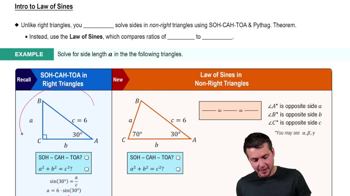
Law of Sines

The Law of Sines is a fundamental principle in trigonometry that relates the ratios of the lengths of sides of a triangle to the sines of its angles. It states that for any triangle, the ratio of a side length to the sine of its opposite angle is constant. This law is particularly useful for solving triangles when given two angles and one side (AAS or ASA) or two sides and a non-included angle (SSA).
추천 영상:
가이드 코스
4:27
Intro to Law of Sines

Triangle Existence Criteria

To determine if a triangle can exist with given side lengths and angles, one must consider the triangle inequality theorem and the conditions for angle measures. Specifically, the sum of the angles in a triangle must equal 180°, and the lengths of any two sides must be greater than the length of the third side. If these conditions are not met, it may result in 'no triangle' or the possibility of two distinct triangles.
추천 영상:
5:35
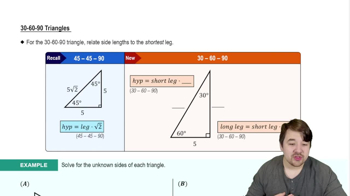
30-60-90 Triangles

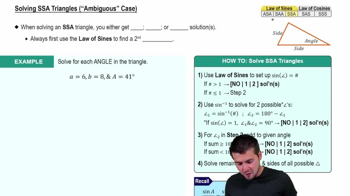
Ambiguous Case of SSA

The ambiguous case of SSA (Side-Side-Angle) occurs when two sides and a non-included angle are known, leading to the possibility of zero, one, or two triangles. This situation arises because the given angle may correspond to two different configurations of the triangle. To resolve this, one must analyze the given measurements to determine if one triangle, two triangles, or no triangle can be formed based on the angle and side lengths provided.
추천 영상:
가이드 코스
9:50
Solving SSA Triangles ("Ambiguous" Case)