Ch. 4 - Laws of Sines and Cosines; Vectors
Blitzer - Trigonometry 3rd Edition
Blitzer3rd EditionTrigonometryISBN: 9780137316601당신이 사용하는 게 아니라요?교과서 변경
4장, 문제 19

In Exercises 13–20, let v be the vector from initial point P₁ to terminal point P₂. Write v in terms of i and j. P₁ = (-3, 4), P₂ = (6, 4)

검증된 단계별 안내
1
Identify the coordinates of the initial point \( P_1 = (-3, 4) \) and the terminal point \( P_2 = (6, 4) \).
Calculate the change in the x-coordinate: \( \Delta x = x_2 - x_1 = 6 - (-3) \).
Calculate the change in the y-coordinate: \( \Delta y = y_2 - y_1 = 4 - 4 \).
Express the vector \( \mathbf{v} \) in terms of \( \mathbf{i} \) and \( \mathbf{j} \) using the changes in coordinates: \( \mathbf{v} = \Delta x \mathbf{i} + \Delta y \mathbf{j} \).
Substitute the calculated values of \( \Delta x \) and \( \Delta y \) into the expression for \( \mathbf{v} \).

비슷한 문제에 대한 검증된 영상 답변:

이 영상 해법은 위 문제에 도움이 된다고 튜터들이 추천한 것입니다.
영상 길이:
2m
도움이 되었나요?

주요 개념

질문에 올바르게 답하기 위해 반드시 이해해야 하는 핵심 개념들은 다음과 같습니다.

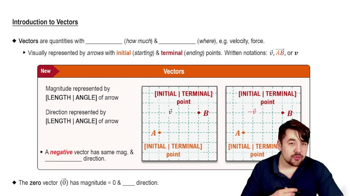
Vectors

A vector is a mathematical object that has both magnitude and direction. In a two-dimensional space, a vector can be represented as an ordered pair (x, y), where x and y denote the horizontal and vertical components, respectively. Understanding vectors is essential for solving problems involving direction and displacement between points.
추천 영상:
03:48
Introduction to Vectors

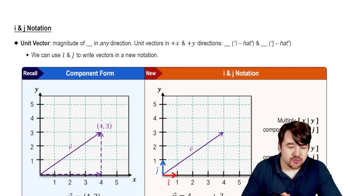
Unit Vectors i and j

In the context of two-dimensional vectors, 'i' and 'j' are the standard unit vectors that represent the x-axis and y-axis directions, respectively. The vector 'i' corresponds to (1, 0) and 'j' corresponds to (0, 1). Any vector can be expressed as a linear combination of these unit vectors, which simplifies vector representation and calculations.
추천 영상:
06:01
i & j Notation

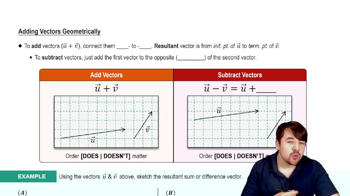
Vector Subtraction

Vector subtraction involves finding the difference between two vectors, which can be interpreted as determining the displacement from one point to another. For points P₁ and P₂, the vector v can be calculated by subtracting the coordinates of P₁ from those of P₂. This operation yields a new vector that indicates the direction and distance from P₁ to P₂.
추천 영상:
05:29
Adding Vectors Geometrically