In Exercises 21–38, let
u = 2i - 5j, v = -3i + 7j, and w = -i - 6j.
Find each specified vector or scalar.
u + v
검증된 단계별 안내
1
Identify the components of vector \( u \) as \( 2i - 5j \).
Identify the components of vector \( v \) as \( -3i + 7j \).
Add the corresponding components of vectors \( u \) and \( v \): \( (2i + (-3i)) \) and \( (-5j + 7j) \).
Simplify the addition of the \( i \) components: \( 2i - 3i \).
Simplify the addition of the \( j \) components: \( -5j + 7j \).
비슷한 문제에 대한 검증된 영상 답변:
이 영상 해법은 위 문제에 도움이 된다고 튜터들이 추천한 것입니다.
영상 길이:
1m
영상 재생:
0 댓글
도움이 되었나요?
주요 개념
질문에 올바르게 답하기 위해 반드시 이해해야 하는 핵심 개념들은 다음과 같습니다.
Vector Addition
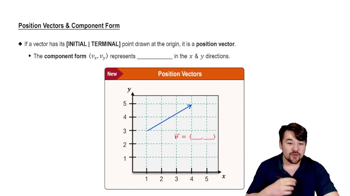
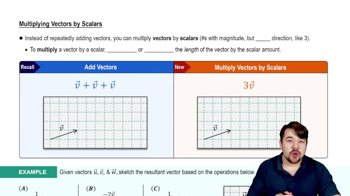
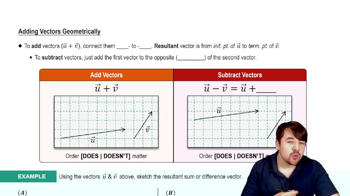
Vector addition involves combining two or more vectors to form a resultant vector. This is done by adding their corresponding components. For example, if vector u has components (2, -5) and vector v has components (-3, 7), their sum is calculated by adding the i-components and the j-components separately, resulting in a new vector.
Vectors can be expressed in component form, typically as a combination of unit vectors i and j in a two-dimensional space. For instance, a vector u = 2i - 5j indicates it has a horizontal component of 2 and a vertical component of -5. Understanding this form is essential for performing operations like addition or subtraction.
The resultant vector is the vector that results from the addition of two or more vectors. It represents the cumulative effect of the individual vectors. In the context of the question, finding u + v will yield a resultant vector that combines the effects of both vectors, providing a new direction and magnitude.


 검증된 단계별 안내
 05:29
05:29