Ch. 4 - Laws of Sines and Cosines; Vectors
Blitzer - Trigonometry 3rd Edition
Blitzer3rd EditionTrigonometryISBN: 9780137316601당신이 사용하는 게 아니라요?교과서 변경
4장, 문제 42

In Exercises 42–43, find projᵥᵥv. Then decompose v into two vectors, v₁ and v₂ where v₁ is parallel to w and v₂ is orthogonal to w.
v = -2i + 5j, w = 5i + 4j

검증된 단계별 안내
1
Identify the vectors \( \mathbf{v} = -2\mathbf{i} + 5\mathbf{j} \) and \( \mathbf{w} = 5\mathbf{i} + 4\mathbf{j} \).
Recall the formula for the projection of \( \mathbf{v} \) onto \( \mathbf{w} \): \[ \text{proj}_{\mathbf{w}} \mathbf{v} = \left( \frac{\mathbf{v} \cdot \mathbf{w}}{\mathbf{w} \cdot \mathbf{w}} \right) \mathbf{w} \] where \( \mathbf{v} \cdot \mathbf{w} \) is the dot product of \( \mathbf{v} \) and \( \mathbf{w} \).
Calculate the dot product \( \mathbf{v} \cdot \mathbf{w} = (-2)(5) + (5)(4) \).
Calculate the dot product \( \mathbf{w} \cdot \mathbf{w} = (5)(5) + (4)(4) \).
Use the values from the dot products to find \( \text{proj}_{\mathbf{w}} \mathbf{v} \) by multiplying the scalar \( \frac{\mathbf{v} \cdot \mathbf{w}}{\mathbf{w} \cdot \mathbf{w}} \) by the vector \( \mathbf{w} \). Then, decompose \( \mathbf{v} \) into: - \( \mathbf{v}_1 = \text{proj}_{\mathbf{w}} \mathbf{v} \) (parallel to \( \mathbf{w} \)) - \( \mathbf{v}_2 = \mathbf{v} - \mathbf{v}_1 \) (orthogonal to \( \mathbf{w} \))

비슷한 문제에 대한 검증된 영상 답변:

이 영상 해법은 위 문제에 도움이 된다고 튜터들이 추천한 것입니다.
영상 길이:
6m
도움이 되었나요?

주요 개념

질문에 올바르게 답하기 위해 반드시 이해해야 하는 핵심 개념들은 다음과 같습니다.

Vector Projection

Vector projection of v onto w, denoted proj_w v, is the component of v that points in the direction of w. It is calculated using the formula proj_w v = (v · w / ||w||²) w, where '·' is the dot product and ||w|| is the magnitude of w. This concept helps in breaking down vectors into parallel components.
추천 영상:
03:48
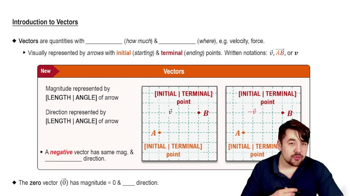
Introduction to Vectors

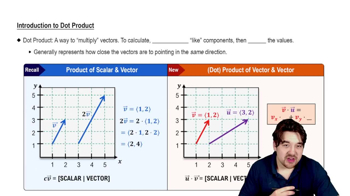
Dot Product of Vectors

The dot product of two vectors v and w is a scalar defined as v · w = v₁w₁ + v₂w₂ for 2D vectors. It measures how much one vector extends in the direction of another and is essential for finding projections and angles between vectors.
추천 영상:
05:40
Introduction to Dot Product

Vector Decomposition into Parallel and Orthogonal Components

Any vector v can be decomposed into two vectors: v₁ parallel to w and v₂ orthogonal to w, such that v = v₁ + v₂. Here, v₁ = proj_w v, and v₂ = v - v₁. This decomposition is useful in many applications like resolving forces or analyzing vector components.
추천 영상:
03:55
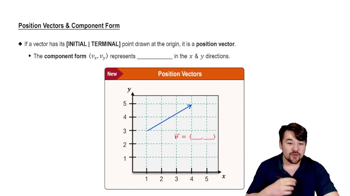
Position Vectors & Component Form