Ch. 4 - Laws of Sines and Cosines; Vectors
Blitzer - Trigonometry 3rd Edition
Blitzer3rd EditionTrigonometryISBN: 9780137316601당신이 사용하는 게 아니라요?교과서 변경
4장, 문제 21

In Exercises 9–24, solve each triangle. Round lengths to the nearest tenth and angle measures to the nearest degree. a = 3, b = 3, c = 3

검증된 단계별 안내
1
insert step 1: Recognize that the given triangle is an equilateral triangle because all sides are equal (a = b = c = 3).
insert step 2: In an equilateral triangle, all angles are equal. Therefore, each angle measures 60 degrees.
insert step 3: Use the Law of Cosines to verify the angle measures. The Law of Cosines states: c^2 = a^2 + b^2 - 2ab \(\cdot\) \(\cos\)(C).
insert step 4: Substitute the known values into the Law of Cosines: 3^2 = 3^2 + 3^2 - 2 \(\cdot\) 3 \(\cdot\) 3 \(\cdot\) \(\cos\)(C).
insert step 5: Simplify the equation to find \(\cos\)(C) and confirm that C = 60 degrees.

비슷한 문제에 대한 검증된 영상 답변:

이 영상 해법은 위 문제에 도움이 된다고 튜터들이 추천한 것입니다.
영상 길이:
5m
도움이 되었나요?

주요 개념

질문에 올바르게 답하기 위해 반드시 이해해야 하는 핵심 개념들은 다음과 같습니다.

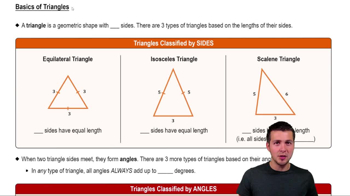
Triangle Properties

Understanding the properties of triangles is essential for solving them. A triangle consists of three sides and three angles, and the sum of the interior angles always equals 180 degrees. In this case, since all sides are equal (a = b = c), the triangle is equilateral, meaning all angles are also equal, each measuring 60 degrees.
추천 영상:
가이드 코스
4:42
Review of Triangles

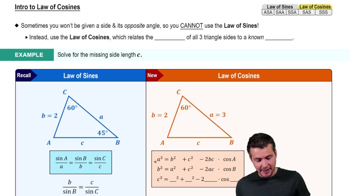
Law of Cosines

The Law of Cosines is a crucial formula used to find unknown sides or angles in any triangle. It states that for any triangle with sides a, b, and c opposite to angles A, B, and C respectively, the relationship is given by c² = a² + b² - 2ab * cos(C). This law is particularly useful when dealing with non-right triangles, as it allows for the calculation of angles and sides based on known values.
추천 영상:
가이드 코스
4:35
Intro to Law of Cosines

Rounding and Precision

Rounding is an important aspect of presenting numerical answers in a clear and concise manner. In this exercise, lengths are to be rounded to the nearest tenth and angles to the nearest degree. This means that when calculating the lengths of sides or measures of angles, one must apply rounding rules to ensure the final answers are appropriately formatted, which is crucial for accuracy in practical applications.
추천 영상:
2:22
Cardioids Example 1