Ch. 5 - Complex Numbers, Polar Coordinates and Parametric Equations
Blitzer - Trigonometry 3rd Edition
Blitzer3rd EditionTrigonometryISBN: 9780137316601당신이 사용하는 게 아니라요?교과서 변경
5장, 문제 7

Perform the indicated operation. Leave answers in polar form. [2(cos 10° + i sin 10°)]⁵

검증된 단계별 안내
1
Recognize that the expression is in polar form, where the complex number is given by \(r(\cos \theta + i \sin \theta)\) with \(r = 2\) and \(\theta = 10^\circ\).
Recall De Moivre's Theorem, which states that for a complex number in polar form, raising it to the power \(n\) results in \(r^n \left( \cos(n\theta) + i \sin(n\theta) \right)\).
Apply De Moivre's Theorem to the given expression: raise the magnitude to the fifth power, \(r^5 = 2^5\), and multiply the angle by 5, \(5 \times 10^\circ\).
Write the resulting expression as \(2^5 \left( \cos(50^\circ) + i \sin(50^\circ) \right)\), which is the polar form of the complex number raised to the fifth power.
Leave the answer in this polar form without converting to rectangular form or calculating the numerical values.

비슷한 문제에 대한 검증된 영상 답변:

이 영상 해법은 위 문제에 도움이 된다고 튜터들이 추천한 것입니다.
영상 길이:
3m
도움이 되었나요?

주요 개념

질문에 올바르게 답하기 위해 반드시 이해해야 하는 핵심 개념들은 다음과 같습니다.

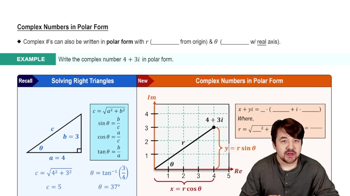
Polar Form of Complex Numbers

A complex number can be expressed in polar form as r(cos θ + i sin θ), where r is the magnitude and θ is the argument (angle). This form is useful for multiplication and exponentiation because it separates the magnitude and angle, simplifying calculations involving powers and roots.
추천 영상:
04:47
Complex Numbers In Polar Form

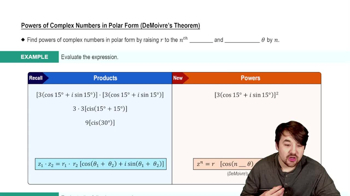
De Moivre's Theorem

De Moivre's Theorem states that for a complex number in polar form, raising it to the nth power results in r^n [cos(nθ) + i sin(nθ)]. This theorem allows easy computation of powers of complex numbers by raising the magnitude to the power and multiplying the angle by n.
추천 영상:
03:41
Powers Of Complex Numbers In Polar Form (DeMoivre's Theorem)

Exponentiation of Complex Numbers in Polar Form

To raise a complex number in polar form to a power, apply De Moivre's Theorem by raising the modulus to the power and multiplying the argument by the exponent. This process yields the result in polar form, which is often preferred for clarity and further operations.
추천 영상:
04:47
Complex Numbers In Polar Form