Ch. 5 - Complex Numbers, Polar Coordinates and Parametric Equations
Blitzer - Trigonometry 3rd Edition
Blitzer3rd EditionTrigonometryISBN: 9780137316601당신이 사용하는 게 아니라요?교과서 변경
5장, 문제 9

Test for symmetry with respect to a. the polar axis. b. the line θ = π/2. c. the pole. r = 4 + 3 cos θ

검증된 단계별 안내
1
Recall the tests for symmetry in polar coordinates: - Symmetry about the polar axis (the horizontal axis) means that if \((r, \theta)\) is on the graph, then \((r, -\theta)\) is also on the graph. - Symmetry about the line \(\theta = \frac{\pi}{2}\) means that if \((r, \theta)\) is on the graph, then \((r, \pi - \theta)\) is also on the graph. - Symmetry about the pole (origin) means that if \((r, \theta)\) is on the graph, then \((-r, \theta)\) or equivalently \((r, \theta + \pi)\) is also on the graph.
To test symmetry about the polar axis, replace \(\theta\) with \(-\theta\) in the equation and check if the equation remains unchanged. For the given equation: \(r = 4 + 3 \cos \theta\) Replace \(\theta\) with \(-\theta\): \(r = 4 + 3 \cos(-\theta)\)
Use the even property of cosine, which states \(\cos(-\theta) = \cos \theta\), so the equation becomes: \(r = 4 + 3 \cos \theta\) Since this is the same as the original equation, the graph is symmetric about the polar axis.
To test symmetry about the line \(\theta = \frac{\pi}{2}\), replace \(\theta\) with \(\pi - \theta\) in the equation and check if the equation remains unchanged: \(r = 4 + 3 \cos(\pi - \theta)\)
Use the identity \(\cos(\pi - \theta) = -\cos \theta\), so the equation becomes: \(r = 4 - 3 \cos \theta\) Since this is not the same as the original equation, the graph is not symmetric about the line \(\theta = \frac{\pi}{2}\).

비슷한 문제에 대한 검증된 영상 답변:

이 영상 해법은 위 문제에 도움이 된다고 튜터들이 추천한 것입니다.
영상 길이:
5m
도움이 되었나요?

주요 개념

질문에 올바르게 답하기 위해 반드시 이해해야 하는 핵심 개념들은 다음과 같습니다.

Symmetry with Respect to the Polar Axis

Symmetry about the polar axis means the graph remains unchanged when θ is replaced by -θ. To test this, substitute -θ into the polar equation and check if the resulting equation is equivalent to the original. This reflects symmetry across the horizontal axis in polar coordinates.
추천 영상:
05:32
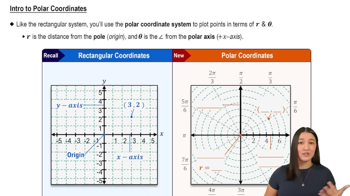
Intro to Polar Coordinates

Symmetry with Respect to the Line θ = π/2

Symmetry about the line θ = π/2 occurs if replacing θ by π - θ yields an equivalent equation. This tests whether the graph is mirrored across the vertical line θ = π/2 in the polar plane. It helps identify vertical symmetry in polar graphs.
추천 영상:
2:22
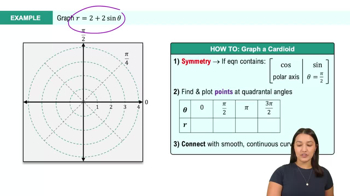
Cardioids Example 1

Symmetry with Respect to the Pole

Symmetry about the pole (origin) means the graph is unchanged when (r, θ) is replaced by (-r, θ) or equivalently (r, θ + π). Testing this involves checking if r(θ) = -r(θ + π) or if the equation remains valid under these transformations, indicating origin symmetry.
추천 영상:
2:22
Cardioids Example 1