Ch. 5 - Complex Numbers, Polar Coordinates and Parametric Equations
Blitzer - Trigonometry 3rd Edition
Blitzer3rd EditionTrigonometryISBN: 9780137316601당신이 사용하는 게 아니라요?교과서 변경
5장, 문제 9

In Exercises 9–20, find each product and write the result in standard form. −3i(7i − 5)

검증된 단계별 안내
1
Recall that the imaginary unit \(i\) has the property \(i^2 = -1\).
Distribute \(-3i\) across the terms inside the parentheses: \(-3i \times 7i\) and \(-3i \times (-5)\).
Calculate each product separately: \(-3i \times 7i = -21i^2\) and \(-3i \times (-5) = 15i\).
Substitute \(i^2\) with \(-1\) in the expression \(-21i^2\) to get \(-21 \times (-1)\).
Simplify the expression to combine the real and imaginary parts, resulting in a number in the form \(a + bi\).

비슷한 문제에 대한 검증된 영상 답변:

이 영상 해법은 위 문제에 도움이 된다고 튜터들이 추천한 것입니다.
영상 길이:
2m
도움이 되었나요?

주요 개념

질문에 올바르게 답하기 위해 반드시 이해해야 하는 핵심 개념들은 다음과 같습니다.

Imaginary Unit (i)

The imaginary unit 'i' is defined as the square root of -1, with the property that i² = -1. It is fundamental in complex numbers and allows for the extension of the real number system to include solutions to equations like x² + 1 = 0.
추천 영상:
06:01
i & j Notation

Multiplication of Complex Numbers

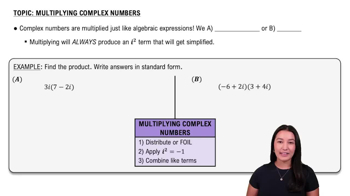
Multiplying complex numbers involves using the distributive property (FOIL method) and applying the rule i² = -1. Each term is multiplied carefully, combining like terms and simplifying to express the result in standard form a + bi.
추천 영상:
5:02
Multiplying Complex Numbers

Standard Form of a Complex Number

The standard form of a complex number is written as a + bi, where 'a' is the real part and 'b' is the coefficient of the imaginary part. Expressing results in this form clearly separates real and imaginary components for easier interpretation.
추천 영상:
04:47
Complex Numbers In Polar Form