
Ch. 1 - Trigonometric Functions
Lial - Trigonometry 12th Edition
Lial12th EditionTrigonometryISBN: 9780136552161당신이 사용하는 게 아니라요?교과서 변경
2장, 문제 47

Concept Check Suppose that the point (x, y) is in the indicated quadrant. Determine whether the given ratio is positive or negative. Recall that r = √(x² + y²) .(Hint: Drawing a sketch may help.) I , y/r

검증된 단계별 안내
1
Recall that the ratio given is \( \frac{y}{r} \), where \( r = \sqrt{x^2 + y^2} \). Since \( r \) is the distance from the origin to the point \( (x, y) \), it is always positive regardless of the quadrant.
Identify the quadrant: The point \( (x, y) \) is in Quadrant I, where both \( x \) and \( y \) coordinates are positive.
Since \( y \) is positive in Quadrant I and \( r \) is always positive, the ratio \( \frac{y}{r} \) is the quotient of two positive numbers.
Therefore, the ratio \( \frac{y}{r} \) must be positive in Quadrant I.
To visualize this, sketch the coordinate plane, plot a point in Quadrant I, draw the radius \( r \) from the origin to the point, and observe that both \( y \) and \( r \) are positive, confirming the positivity of the ratio.

비슷한 문제에 대한 검증된 영상 답변:

이 영상 해법은 위 문제에 도움이 된다고 튜터들이 추천한 것입니다.
영상 길이:
2m
도움이 되었나요?

주요 개념

질문에 올바르게 답하기 위해 반드시 이해해야 하는 핵심 개념들은 다음과 같습니다.

Coordinate Plane Quadrants

The coordinate plane is divided into four quadrants, each with specific signs for x and y coordinates. In Quadrant I, both x and y are positive, which affects the sign of ratios involving these values.
추천 영상:
6:36
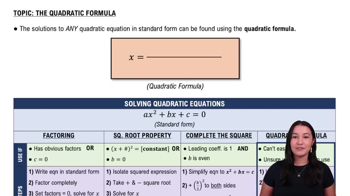
Quadratic Formula

Definition of r in Trigonometry

The variable r represents the distance from the origin to the point (x, y), calculated as r = √(x² + y²). Since it is a distance, r is always positive, regardless of the quadrant.
추천 영상:
5:32
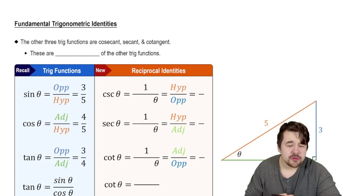
Fundamental Trigonometric Identities

Sign of Trigonometric Ratios

Trigonometric ratios like y/r correspond to sine of the angle formed by the point and the x-axis. The sign of y/r depends on the sign of y and the always positive r, so in Quadrant I, y/r is positive.
추천 영상:
6:04
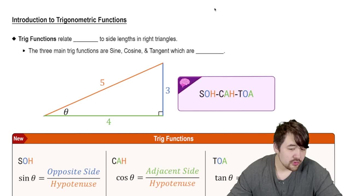
Introduction to Trigonometric Functions