Ch. 1 - Trigonometric Functions
Lial - Trigonometry 12th Edition
Lial12th EditionTrigonometryISBN: 9780136552161당신이 사용하는 게 아니라요?교과서 변경
2장, 문제 46

Identify the quadrant (or possible quadrants) of an angle θ that satisfies the given conditions. See Example 3.
csc θ > 0 , cot θ > 0

검증된 단계별 안내
1
Recall the definitions and signs of the trigonometric functions in each quadrant. The cosecant function, \(\csc \theta\), is the reciprocal of sine, so \(\csc \theta = \frac{1}{\sin \theta}\). Therefore, \(\csc \theta > 0\) means \(\sin \theta > 0\).
Determine in which quadrants \(\sin \theta\) is positive. Since sine corresponds to the y-coordinate on the unit circle, \(\sin \theta > 0\) in Quadrant I and Quadrant II.
Next, analyze the condition \(\cot \theta > 0\). Recall that \(\cot \theta = \frac{\cos \theta}{\sin \theta}\). For \(\cot \theta\) to be positive, the ratio \(\frac{\cos \theta}{\sin \theta}\) must be positive, meaning \(\cos \theta\) and \(\sin \theta\) have the same sign.
Since from step 2, \(\sin \theta > 0\), for \(\cot \theta\) to be positive, \(\cos \theta\) must also be positive. Identify the quadrants where both \(\sin \theta\) and \(\cos \theta\) are positive.
Conclude that the angle \(\theta\) must lie in Quadrant I, where both sine and cosine are positive, satisfying both \(\csc \theta > 0\) and \(\cot \theta > 0\).

비슷한 문제에 대한 검증된 영상 답변:

이 영상 해법은 위 문제에 도움이 된다고 튜터들이 추천한 것입니다.
영상 길이:
3m
도움이 되었나요?

주요 개념

질문에 올바르게 답하기 위해 반드시 이해해야 하는 핵심 개념들은 다음과 같습니다.

Signs of Trigonometric Functions in Quadrants

The signs of sine, cosine, tangent, and their reciprocals vary depending on the quadrant of the angle. For example, sine and cosecant are positive in Quadrants I and II, while cotangent is positive in Quadrants I and III. Understanding these sign patterns helps determine the possible quadrants for an angle.
추천 영상:
6:36
Quadratic Formula

Reciprocal Trigonometric Functions

Cosecant (csc) is the reciprocal of sine (sin), and cotangent (cot) is the reciprocal of tangent (tan). Knowing these relationships allows you to infer the sign of sine and tangent from the signs of cosecant and cotangent, which is essential for identifying the correct quadrant.
추천 영상:
6:04
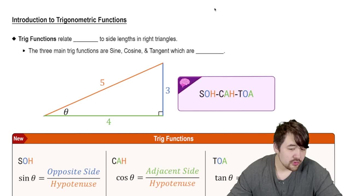
Introduction to Trigonometric Functions

Quadrant Determination Using Multiple Conditions

When given multiple inequalities involving trigonometric functions, the solution involves finding the intersection of quadrants where all conditions hold true. This requires combining the sign information of each function to narrow down the possible quadrants for the angle θ.
추천 영상:
6:12
Solving Quadratic Equations by the Square Root Property