Ch. 1 - Trigonometric Functions
Lial - Trigonometry 12th Edition
Lial12th EditionTrigonometryISBN: 9780136552161당신이 사용하는 게 아니라요?교과서 변경
2장, 문제 55

Convert each angle measure to decimal degrees. If applicable, round to the nearest thousandth of a degree. 112° 15'

검증된 단계별 안내
1
Identify the components of the angle: 112° (degrees) and 15' (minutes). Remember that 1 degree = 60 minutes.
Convert the minutes to decimal degrees by dividing the number of minutes by 60. Use the formula: \(\text{Decimal degrees from minutes} = \frac{\text{minutes}}{60}\).
Calculate the decimal degrees from the minutes: \(\frac{15}{60}\).
Add the decimal degrees obtained from the minutes to the whole degrees to get the total angle in decimal degrees: \(112 + \frac{15}{60}\).
If required, round the final decimal degree value to the nearest thousandth.

비슷한 문제에 대한 검증된 영상 답변:

이 영상 해법은 위 문제에 도움이 된다고 튜터들이 추천한 것입니다.
영상 길이:
1m
도움이 되었나요?

주요 개념

질문에 올바르게 답하기 위해 반드시 이해해야 하는 핵심 개념들은 다음과 같습니다.

Degrees, Minutes, and Seconds (DMS) Notation

Angles can be expressed in degrees (°), minutes ('), and seconds ("), where 1 degree equals 60 minutes and 1 minute equals 60 seconds. This notation is commonly used in navigation and surveying to represent precise angle measures.
추천 영상:
06:01
i & j Notation

Conversion from Minutes to Decimal Degrees

To convert minutes to decimal degrees, divide the number of minutes by 60 since there are 60 minutes in one degree. For example, 15 minutes equals 15/60 = 0.25 degrees, which can then be added to the whole degrees.
추천 영상:
03:58
Converting Complex Numbers from Polar to Rectangular Form

Rounding Decimal Degrees

After converting the angle to decimal degrees, rounding to the nearest thousandth means keeping three digits after the decimal point. This ensures a precise yet manageable representation of the angle for practical use.
추천 영상:
5:04
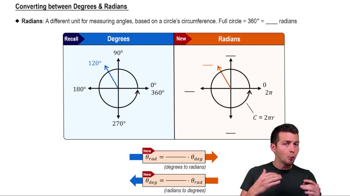
Converting between Degrees & Radians