Ch. 1 - Trigonometric Functions
Lial - Trigonometry 12th Edition
Lial12th EditionTrigonometryISBN: 9780136552161당신이 사용하는 게 아니라요?교과서 변경
2장, 문제 72

Convert each angle measure to degrees, minutes, and seconds. If applicable, round to the nearest second. 59.0854°

검증된 단계별 안내
1
Identify the given angle in decimal degrees: \(59.0854^\circ\).
Separate the whole number part from the decimal part. The whole number part is the degrees: \(59^\circ\).
Convert the decimal part (0.0854) to minutes by multiplying by 60: \(0.0854 \times 60\).
Separate the whole number part of the minutes from the decimal part. The whole number is the minutes.
Convert the remaining decimal part of the minutes to seconds by multiplying by 60, then round to the nearest second if necessary.

비슷한 문제에 대한 검증된 영상 답변:

이 영상 해법은 위 문제에 도움이 된다고 튜터들이 추천한 것입니다.
영상 길이:
3m
도움이 되었나요?

주요 개념

질문에 올바르게 답하기 위해 반드시 이해해야 하는 핵심 개념들은 다음과 같습니다.

Decimal Degrees to Degrees, Minutes, and Seconds Conversion

This concept involves converting an angle expressed in decimal degrees into degrees, minutes, and seconds (D° M' S"). Degrees remain the integer part, minutes are obtained by multiplying the decimal remainder by 60, and seconds come from multiplying the remaining decimal after minutes by 60 again.
추천 영상:
5:04
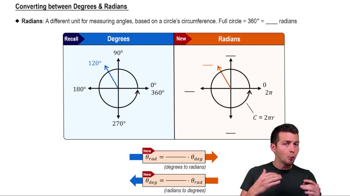
Converting between Degrees & Radians

Rounding to the Nearest Second

After calculating seconds in the conversion process, it is often necessary to round the value to the nearest whole number to simplify the angle measure. This ensures the angle is expressed in a standard format suitable for practical use, such as navigation or surveying.
추천 영상:
4:45
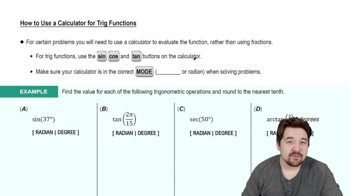
How to Use a Calculator for Trig Functions

Understanding Angle Measurement Units

Degrees, minutes, and seconds are units used to measure angles, where 1 degree equals 60 minutes and 1 minute equals 60 seconds. This hierarchical structure allows for precise representation of angles, especially when decimal degrees are not convenient or preferred.
추천 영상:
5:31
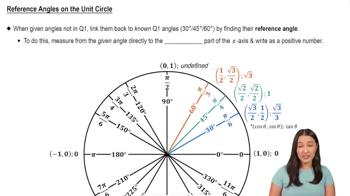
Reference Angles on the Unit Circle