Ch. 1 - Trigonometric Functions
Lial - Trigonometry 12th Edition
Lial12th EditionTrigonometryISBN: 9780136552161당신이 사용하는 게 아니라요?교과서 변경
2장, 문제 69

Find the indicated function value. If it is undefined, say so. See Example 4. sin(―270°)

검증된 단계별 안내
1
Recall the definition of the sine function for negative angles: \(\sin(-\theta) = -\sin(\theta)\).
Rewrite the given expression using this identity: \(\sin(-270^\circ) = -\sin(270^\circ)\).
Determine the value of \(\sin(270^\circ)\) by considering the unit circle. The angle \(270^\circ\) corresponds to the point \((0, -1)\) on the unit circle, so \(\sin(270^\circ) = -1\).
Substitute this value back into the expression: \(\sin(-270^\circ) = -(-1)\).
Simplify the expression to find the value of \(\sin(-270^\circ)\).

비슷한 문제에 대한 검증된 영상 답변:

이 영상 해법은 위 문제에 도움이 된다고 튜터들이 추천한 것입니다.
영상 길이:
1m
도움이 되었나요?

주요 개념

질문에 올바르게 답하기 위해 반드시 이해해야 하는 핵심 개념들은 다음과 같습니다.

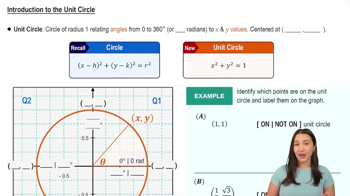
Understanding the Unit Circle and Angle Measurement

The unit circle is a circle with radius 1 centered at the origin of the coordinate plane. Angles are measured from the positive x-axis, with positive angles rotating counterclockwise and negative angles clockwise. Knowing how to locate angles like -270° on the unit circle helps determine the sine value.
추천 영상:
06:11
Introduction to the Unit Circle

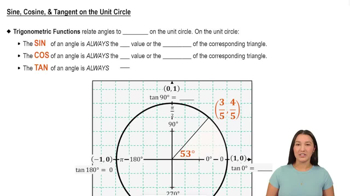
Sine Function Definition on the Unit Circle

The sine of an angle corresponds to the y-coordinate of the point where the terminal side of the angle intersects the unit circle. This means sin(θ) equals the vertical position on the circle, which can be positive, negative, or zero depending on the angle's quadrant.
추천 영상:
6:34
Sine, Cosine, & Tangent on the Unit Circle

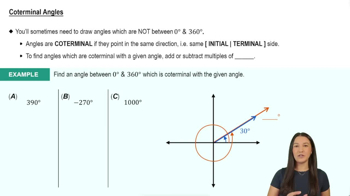
Angle Coterminality and Reference Angles

Angles differing by full rotations (multiples of 360°) share the same terminal side and thus the same sine value. To find sin(-270°), convert it to a coterminal positive angle by adding 360°, simplifying the evaluation using known sine values of standard angles.
추천 영상:
04:46
Coterminal Angles
관련 실천
교과서 질문

Convert each angle measure to degrees, minutes, and seconds. If applicable, round to the nearest second. -25.485°

707
views

교과서 질문

Convert each angle measure to degrees, minutes, and seconds. If applicable, round to the nearest second. See Example 4(b). 174.255°

629
views
교과서 질문

Use identities to solve each of the following. Rationalize denominators when applicable. See Examples 5–7. Find csc θ , given that cot θ = ―1/2 and θ is in quadrant IV.

701
views
교과서 질문

Convert each angle measure to degrees, minutes, and seconds. If applicable, round to the nearest second. 59.0854°

707
views
교과서 질문

Use identities to solve each of the following. Rationalize denominators when applicable. See Examples 5–7. Find cot θ , given that csc θ = ―1.45 and θ is in quadrant III.

798
views
1
rank
교과서 질문

Solve each problem. Solar Eclipse on Earth The sun has a diameter of about 865,000 mi with a maximum distance from Earth's surface of about 94,500,000 mi. The moon has a smaller diameter of 2159 mi. For a total solar eclipse to occur, the moon must pass between Earth and the sun. The moon must also be close enough to Earth for the moon's umbra (shadow) to reach the surface of Earth. (Data from Karttunen, H., P. Kröger, H. Oja, M. Putannen, and K. Donners, Editors, Fundamental Astronomy, Fourth Edition, Springer-Verlag.) a. Calculate the maximum distance, to the nearest thousand miles, that the moon can be from Earth and still have a total solar eclipse occur. (Hint: Use similar triangles.)

804
views