Ch. 1 - Trigonometric Functions
Lial - Trigonometry 12th Edition
Lial12th EditionTrigonometryISBN: 9780136552161당신이 사용하는 게 아니라요?교과서 변경
2장, 문제 3.73

Find the exact values of s in the given interval that satisfy the given condition.


[0, 2π) ; sin s = -√3/ 2

검증된 단계별 안내
1
Identify the reference angle whose sine value is \(\sqrt{3}/2\). The reference angle is \(\pi/3\) because \(\sin(\pi/3) = \sqrt{3}/2\).
Since the sine value is negative as given by \(\sin s = -\sqrt{3}/2\), focus on the quadrants where sine is negative, which are the third and fourth quadrants.
Determine the angles in the third and fourth quadrants that correspond to the reference angle \(\pi/3\). These angles are \(\pi + \pi/3\) and \(2\pi - \pi/3\).
Calculate the specific angles: \(\pi + \pi/3 = 4\pi/3\) and \(2\pi - \pi/3 = 5\pi/3\).
Conclude that the angles \(s\) in the interval \([0, 2\pi)\) that satisfy \(\sin s = -\sqrt{3}/2\) are \(s = 4\pi/3\) and \(s = 5\pi/3\).

주요 개념

질문에 올바르게 답하기 위해 반드시 이해해야 하는 핵심 개념들은 다음과 같습니다.

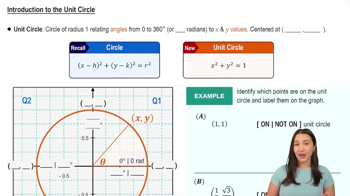
Unit Circle

The unit circle is a circle with a radius of one centered at the origin of a coordinate plane. It is fundamental in trigonometry as it provides a geometric representation of the sine and cosine functions. The angles measured in radians correspond to points on the circle, where the x-coordinate represents cosine and the y-coordinate represents sine.
추천 영상:
06:11
Introduction to the Unit Circle

Sine Function

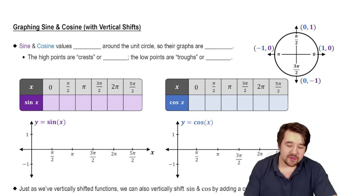
The sine function, denoted as sin(θ), is a fundamental trigonometric function that relates the angle θ to the ratio of the length of the opposite side to the hypotenuse in a right triangle. In the context of the unit circle, it gives the y-coordinate of a point on the circle corresponding to the angle θ. Understanding the values of sine for specific angles is crucial for solving trigonometric equations.
추천 영상:
5:53
Graph of Sine and Cosine Function

Quadrants of the Unit Circle

The unit circle is divided into four quadrants, each corresponding to different signs of the sine and cosine values. In the first quadrant, both sine and cosine are positive; in the second, sine is positive and cosine is negative; in the third, both are negative; and in the fourth, sine is negative and cosine is positive. For the equation sin(s) = -√3/2, we need to identify the angles in the third and fourth quadrants where sine takes on this negative value.
추천 영상:
06:11
Introduction to the Unit Circle