
Ch. 1 - Trigonometric Functions
Lial - Trigonometry 12th Edition
Lial12th EditionTrigonometryISBN: 9780136552161당신이 사용하는 게 아니라요?교과서 변경
2장, 문제 15

Find the measure of (a) the complement and (b) the supplement of an angle with the given measure. See Examples 1 and 3. 54°

검증된 단계별 안내
1
Understand the definitions: The complement of an angle is what, when added to the angle, equals 90°. The supplement of an angle is what, when added to the angle, equals 180°.
To find the complement of the given angle (54°), set up the equation: \(\text{complement} + 54^\circ = 90^\circ\).
Solve for the complement by subtracting 54° from 90°: \(\text{complement} = 90^\circ - 54^\circ\).
To find the supplement of the given angle (54°), set up the equation: \(\text{supplement} + 54^\circ = 180^\circ\).
Solve for the supplement by subtracting 54° from 180°: \(\text{supplement} = 180^\circ - 54^\circ\).

비슷한 문제에 대한 검증된 영상 답변:

이 영상 해법은 위 문제에 도움이 된다고 튜터들이 추천한 것입니다.
영상 길이:
2m
도움이 되었나요?

주요 개념

질문에 올바르게 답하기 위해 반드시 이해해야 하는 핵심 개념들은 다음과 같습니다.

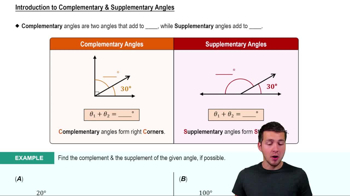
Complementary Angles

Complementary angles are two angles whose measures add up to 90 degrees. To find the complement of a given angle, subtract the angle's measure from 90°. For example, the complement of 54° is 90° - 54° = 36°.
추천 영상:
3:35
Intro to Complementary & Supplementary Angles

Supplementary Angles

Supplementary angles are two angles whose measures add up to 180 degrees. To find the supplement of a given angle, subtract the angle's measure from 180°. For example, the supplement of 54° is 180° - 54° = 126°.
추천 영상:
3:35
Intro to Complementary & Supplementary Angles

Angle Measurement and Units

Angles are measured in degrees, representing the amount of rotation between two rays. Understanding how to manipulate and interpret these measurements is essential for solving problems involving complements and supplements.
추천 영상:
5:31
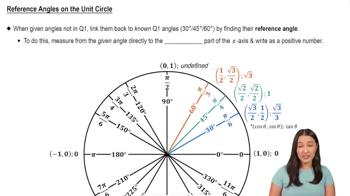
Reference Angles on the Unit Circle