Ch. 1 - Trigonometric Functions
Lial - Trigonometry 12th Edition
Lial12th EditionTrigonometryISBN: 9780136552161당신이 사용하는 게 아니라요?교과서 변경
2장, 문제 16

Find the measure of each marked angle. In Exercises 19–22, m and n are parallel. See Examples 1 and 2 .

검증된 단계별 안내
1
Identify the given information: lines \(m\) and \(n\) are parallel, and there are marked angles formed by a transversal intersecting these parallel lines.
Recall the key angle relationships when a transversal crosses parallel lines: corresponding angles are equal, alternate interior angles are equal, and consecutive interior angles are supplementary (sum to \(180^\circ\)).
Use the given angle measures (if any) and apply these angle relationships to set up equations for the unknown marked angles.
Solve the equations step-by-step to find the measure of each marked angle, ensuring to use the properties of parallel lines and transversals.
Double-check your answers by verifying that the angles satisfy the relationships (e.g., corresponding angles are equal, supplementary angles add up to \(180^\circ\)) to confirm correctness.

비슷한 문제에 대한 검증된 영상 답변:

이 영상 해법은 위 문제에 도움이 된다고 튜터들이 추천한 것입니다.
영상 길이:
2m
도움이 되었나요?

주요 개념

질문에 올바르게 답하기 위해 반드시 이해해야 하는 핵심 개념들은 다음과 같습니다.

Parallel Lines and Transversals

When two lines are parallel and cut by a transversal, several angle relationships arise, such as corresponding, alternate interior, and alternate exterior angles. These relationships help determine unknown angle measures by establishing equality or supplementary conditions.
추천 영상:
1:30
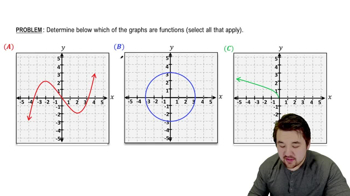
Example 1

Angle Relationships (Corresponding, Alternate Interior, and Consecutive Interior Angles)

Corresponding angles are equal, alternate interior angles are equal, and consecutive interior angles are supplementary when formed by parallel lines and a transversal. Recognizing these relationships is essential for finding unknown angles in geometric figures.
추천 영상:
05:06
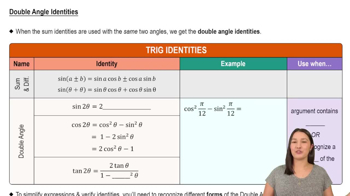
Double Angle Identities

Using Algebra to Solve for Unknown Angles

Often, marked angles are expressed in terms of variables. Setting up equations based on angle relationships allows solving for these variables, which then gives the measure of each angle. This combines geometric reasoning with algebraic manipulation.
추천 영상:
04:42
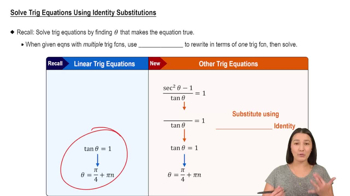
Solve Trig Equations Using Identity Substitutions