Ch. 4 - Graphs of the Circular Functions
Lial - Trigonometry 12th Edition
Lial12th EditionTrigonometryISBN: 9780136552161당신이 사용하는 게 아니라요?교과서 변경
5장, 문제 4.28

Graph each function over a one-period interval.
y = -1 + csc x

검증된 단계별 안내
1
Step 1: Understand the function y = -1 + \(\csc\) x. The function \(\csc\) x is the cosecant function, which is the reciprocal of the sine function, \(\csc\) x = \(\frac{1}{\sin x}\).
Step 2: Identify the period of the function \(\csc\) x. Since \(\csc\) x is derived from \(\sin\) x, it has the same period as \(\sin\) x, which is 2\(\pi\).
Step 3: Determine the vertical shift. The function y = -1 + \(\csc\) x indicates a vertical shift of -1 unit. This means the entire graph of \(\csc\) x is shifted downward by 1 unit.
Step 4: Identify the vertical asymptotes. The function \(\csc\) x has vertical asymptotes where \(\sin\) x = 0, which occur at x = n\(\pi\), where n is an integer. These asymptotes will also apply to y = -1 + \(\csc\) x.
Step 5: Sketch the graph over one period. Start from x = 0 to x = 2\(\pi\), plot the vertical asymptotes, and sketch the transformed \(\csc\) x curve, considering the vertical shift of -1.

비슷한 문제에 대한 검증된 영상 답변:

이 영상 해법은 위 문제에 도움이 된다고 튜터들이 추천한 것입니다.
도움이 되었나요?

주요 개념

질문에 올바르게 답하기 위해 반드시 이해해야 하는 핵심 개념들은 다음과 같습니다.

Cosecant Function

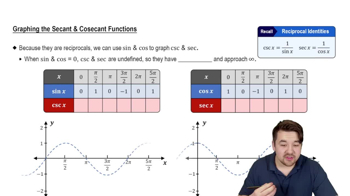
The cosecant function, denoted as csc(x), is the reciprocal of the sine function. It is defined as csc(x) = 1/sin(x). The cosecant function has a range of all real numbers except for values between -1 and 1, and it is undefined wherever sin(x) equals zero. Understanding its behavior is crucial for graphing functions that involve csc(x).
추천 영상:
6:22
Graphs of Secant and Cosecant Functions

Vertical Shifts

Vertical shifts occur when a constant is added to or subtracted from a function. In the given function y = -1 + csc(x), the '-1' indicates a downward shift of the entire cosecant graph by one unit. This transformation affects the function's range and the position of its asymptotes, which are critical for accurately graphing the function.
추천 영상:
6:31
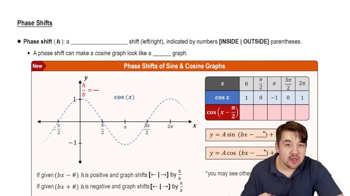
Phase Shifts

Periodicity of Trigonometric Functions

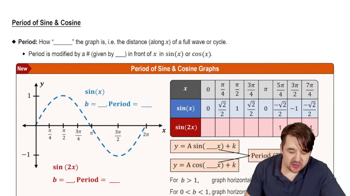
Trigonometric functions, including the cosecant function, are periodic, meaning they repeat their values in regular intervals. The period of csc(x) is 2π, which means the function will complete one full cycle over this interval. Recognizing the periodic nature of the function is essential for graphing it accurately over a one-period interval.
추천 영상:
5:33
Period of Sine and Cosine Functions