Ch. 7 - Applications of Trigonometry and Vectors
Lial - Trigonometry 12th Edition
Lial12th EditionTrigonometryISBN: 9780136552161당신이 사용하는 게 아니라요?교과서 변경
8장, 문제 21

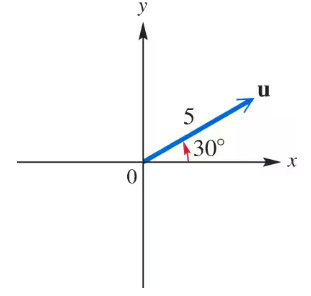
Write each vector in the form 〈a, b〉. Write answers using exact values or to four decimal places, as appropriate.


Vector u with magnitude 5 at a 30-degree angle from the positive x-axis in a Cartesian coordinate system.

검증된 단계별 안내
1
Identify the given vectors from the image and note their magnitudes and directions (angles) if provided.
Recall that a vector in the form \( \langle a, b \rangle \) can be expressed using its magnitude \( r \) and direction angle \( \theta \) as \( \langle r \cos(\theta), r \sin(\theta) \rangle \).
For each vector, use the cosine of the angle to find the \( a \) component (the horizontal or x-component): \( a = r \cos(\theta) \).
Use the sine of the angle to find the \( b \) component (the vertical or y-component): \( b = r \sin(\theta) \).
Write each vector in the form \( \langle a, b \rangle \) using exact values (like \( \sqrt{3}/2 \)) or decimal approximations rounded to four decimal places as appropriate.

비슷한 문제에 대한 검증된 영상 답변:

이 영상 해법은 위 문제에 도움이 된다고 튜터들이 추천한 것입니다.
도움이 되었나요?

주요 개념

질문에 올바르게 답하기 위해 반드시 이해해야 하는 핵심 개념들은 다음과 같습니다.

Vector Representation in Component Form

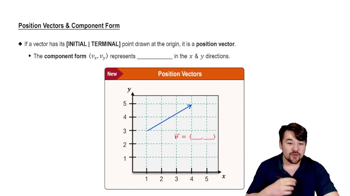
Vectors in the plane can be expressed as ordered pairs 〈a, b〉, where 'a' and 'b' represent the horizontal (x) and vertical (y) components, respectively. This form allows for easy manipulation and calculation of vector properties such as magnitude and direction.
추천 영상:
03:55
Position Vectors & Component Form

Trigonometric Functions for Component Calculation

To find the components of a vector given its magnitude and direction, use trigonometric functions: the x-component is magnitude × cos(θ), and the y-component is magnitude × sin(θ), where θ is the angle the vector makes with the positive x-axis.
추천 영상:
03:55
Position Vectors & Component Form

Exact Values and Decimal Approximations

When expressing vector components, exact values involve using known trigonometric values (like √2/2 for 45°), while decimal approximations round these values to a specified number of decimal places, such as four, to balance precision and practicality.
추천 영상:
6:04
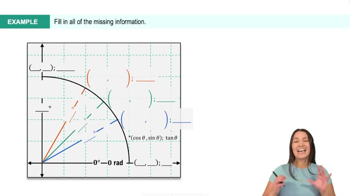
Example 1