Ch. 7 - Applications of Trigonometry and Vectors
Lial - Trigonometry 12th Edition
Lial12th EditionTrigonometryISBN: 9780136552161당신이 사용하는 게 아니라요?교과서 변경
8장, 문제 21

For each pair of vectors u and v with angle θ between them, sketch the resultant.


|u| = 20, |v| = 30, θ = 30°

검증된 단계별 안내
1
Identify the given information: the magnitudes of vectors \( \mathbf{u} \) and \( \mathbf{v} \) are \( |\mathbf{u}| = 20 \) and \( |\mathbf{v}| = 30 \), and the angle between them is \( \theta = 30^\circ \).
Recall that the resultant vector \( \mathbf{r} = \mathbf{u} + \mathbf{v} \) can be found using the law of cosines for vectors, where the magnitude of \( \mathbf{r} \) is given by: \[ \\|\mathbf{r}\\\| = \sqrt{ |\mathbf{u}|^2 + |\mathbf{v}|^2 + 2 |\mathbf{u}| |\mathbf{v}| \cos(\theta) } \]
To sketch the resultant, start by drawing vector \( \mathbf{u} \) as an arrow of length 20 units in any direction.
Next, from the tip of \( \mathbf{u} \), draw vector \( \mathbf{v} \) at an angle of \( 30^\circ \) relative to \( \mathbf{u} \), with length 30 units.
The resultant vector \( \mathbf{r} \) is represented by the arrow drawn from the tail of \( \mathbf{u} \) to the tip of \( \mathbf{v} \). This completes the vector addition and visually shows the resultant.

비슷한 문제에 대한 검증된 영상 답변:

이 영상 해법은 위 문제에 도움이 된다고 튜터들이 추천한 것입니다.
도움이 되었나요?

주요 개념

질문에 올바르게 답하기 위해 반드시 이해해야 하는 핵심 개념들은 다음과 같습니다.

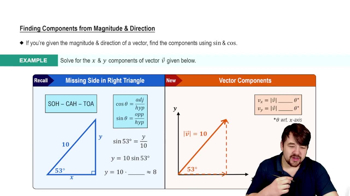
Vector Magnitude and Direction

A vector is defined by its magnitude (length) and direction. Understanding how to represent vectors graphically involves drawing arrows with lengths proportional to their magnitudes and angles corresponding to their directions. This is essential for accurately sketching vectors u and v with given magnitudes and the angle θ between them.
추천 영상:
04:55
Finding Components from Direction and Magnitude

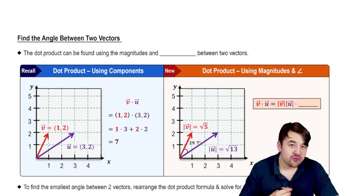
Angle Between Vectors

The angle θ between two vectors is the measure of the smallest rotation from one vector to the other. It determines how the vectors are oriented relative to each other and affects the resultant vector's magnitude and direction when the vectors are added.
추천 영상:
04:33
Find the Angle Between Vectors

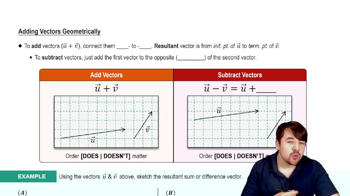
Vector Addition and Resultant Vector

The resultant vector is found by adding two vectors head-to-tail, combining their magnitudes and directions. Using the law of cosines or parallelogram method, the magnitude and direction of the resultant can be determined, which is crucial for sketching the resultant vector from u and v with a known angle θ.
추천 영상:
05:29
Adding Vectors Geometrically