Ch. 7 - Applications of Trigonometry and Vectors
Lial - Trigonometry 12th Edition
Lial12th EditionTrigonometryISBN: 9780136552161당신이 사용하는 게 아니라요?교과서 변경
8장, 문제 32

Two rescue vessels are pulling a broken-down motorboat toward a boathouse with forces of 840 lb and 960 lb. The angle between these forces is 24.5°. Find the direction and magnitude of the equilibrant.

검증된 단계별 안내
1
Identify the two forces acting on the motorboat: \(F_1 = 840\) lb and \(F_2 = 960\) lb, with an angle \(\theta = 24.5^\circ\) between them.
Calculate the resultant force \(\vec{R}\) by using the Law of Cosines to find its magnitude: \(R = \sqrt{F_1^2 + F_2^2 + 2 F_1 F_2 \cos(\theta)}\).
Find the direction of the resultant force relative to the first force \(F_1\) using the Law of Sines or the formula: \(\alpha = \arctan\left(\frac{F_2 \sin(\theta)}{F_1 + F_2 \cos(\theta)}\right)\), where \(\alpha\) is the angle between \(F_1\) and \(\vec{R}\).
Understand that the equilibrant force \(\vec{E}\) is equal in magnitude but opposite in direction to the resultant force \(\vec{R}\), so its magnitude is the same as \(R\) and its direction is \(\alpha + 180^\circ\) (or directly opposite to \(\vec{R}\)).
Summarize the final answers: the magnitude of the equilibrant is \(R\), and its direction is \(\alpha + 180^\circ\) relative to the direction of \(F_1\).

비슷한 문제에 대한 검증된 영상 답변:

이 영상 해법은 위 문제에 도움이 된다고 튜터들이 추천한 것입니다.
도움이 되었나요?

주요 개념

질문에 올바르게 답하기 위해 반드시 이해해야 하는 핵심 개념들은 다음과 같습니다.

Vector Addition of Forces

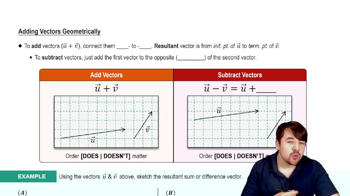
When two forces act at an angle, their combined effect is found by vector addition. This involves calculating the resultant force's magnitude and direction using the magnitudes of the individual forces and the angle between them.
추천 영상:
05:29
Adding Vectors Geometrically

Law of Cosines

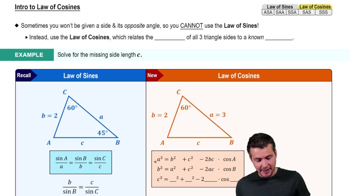
The Law of Cosines relates the lengths of sides in a triangle to the cosine of one angle. It is used here to find the magnitude of the resultant force when two forces form a known angle, by treating the forces as sides of a triangle.
추천 영상:
4:35
Intro to Law of Cosines

Equilibrant Force

The equilibrant force is the force that balances the resultant force, having the same magnitude but opposite direction. It ensures the system is in equilibrium, meaning no net force acts on the object.
추천 영상:
04:39
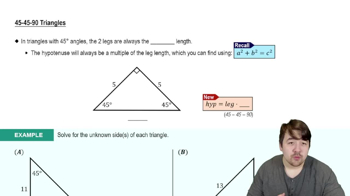
45-45-90 Triangles