
교과서 질문
Apply the law of sines to the following: a = √5, c = 2√5, A = 30°. What is the value of sin C? What is the measure of C? Based on its angle measures, what kind of triangle is triangle ABC?
706
views

 검증된 단계별 안내
 06:01
06:01
 04:55
04:55 04:12
04:12Apply the law of sines to the following: a = √5, c = 2√5, A = 30°. What is the value of sin C? What is the measure of C? Based on its angle measures, what kind of triangle is triangle ABC?
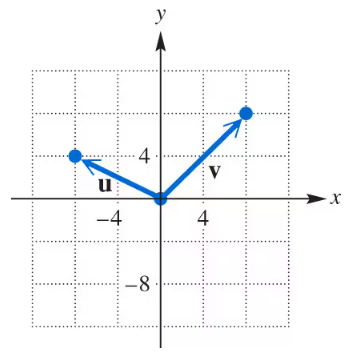
Use the figure to find each vector: u - v. Use vector notation as in Example 4.
Use the figure to find each vector: u + v. Use vector notation as in Example 4.
Solve each triangle. See Examples 2 and 3.
A = 112.8°, b = 6.28 m, c = 12.2 m
Two forces of 692 newtons and 423 newtons act on a point. The resultant force is 786 newtons. Find the angle between the forces.
Two rescue vessels are pulling a broken-down motorboat toward a boathouse with forces of 840 lb and 960 lb. The angle between these forces is 24.5°. Find the direction and magnitude of the equilibrant.