Ch. R - Algebra Review
Lial - Trigonometry 12th Edition
Lial12th EditionTrigonometryISBN: 9780136552161당신이 사용하는 게 아니라요?교과서 변경
1장, 문제 87

Add or subtract, as indicated. See Example 6. 5√3 - √3

검증된 단계별 안내
1
Identify the like terms in the expression. Here, both terms contain the square root of 3, so they are like terms: \(5\sqrt{3}\) and \(\sqrt{3}\).
Rewrite the expression to clearly show the coefficients of the like terms: \(5\sqrt{3} - 1\sqrt{3}\).
Subtract the coefficients of the like terms while keeping the square root part unchanged: \((5 - 1)\sqrt{3}\).
Simplify the subtraction inside the parentheses: \(4\sqrt{3}\).
Write the final simplified expression as \(4\sqrt{3}\), which is the result of the subtraction.

비슷한 문제에 대한 검증된 영상 답변:

이 영상 해법은 위 문제에 도움이 된다고 튜터들이 추천한 것입니다.
영상 길이:
1m
도움이 되었나요?

주요 개념

질문에 올바르게 답하기 위해 반드시 이해해야 하는 핵심 개념들은 다음과 같습니다.

Like Terms in Radicals

Radical expressions can be combined only if they have the same radicand (the number inside the root). For example, terms with √3 can be added or subtracted by combining their coefficients, similar to combining like terms in algebra.
추천 영상:
3:42
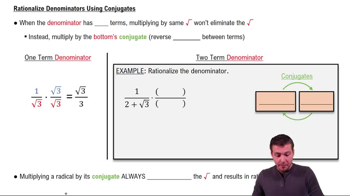
Rationalizing Denominators Using Conjugates

Simplifying Radicals

Before adding or subtracting radicals, ensure each radical is in its simplest form. Simplifying involves factoring out perfect squares from under the root to make combining terms easier and more accurate.
추천 영상:
6:36
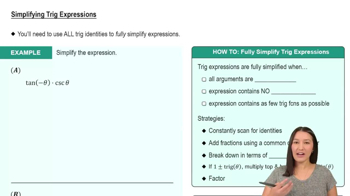
Simplifying Trig Expressions

Arithmetic with Coefficients

When adding or subtracting like radicals, treat the coefficients (numbers in front) as regular numbers. For example, 5√3 - √3 equals (5 - 1)√3 = 4√3, by subtracting the coefficients 5 and 1.
추천 영상:
5:35
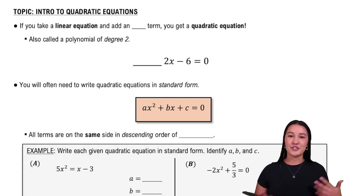
Introduction to Quadratic Equations