Ch. R - Algebra Review
Lial - Trigonometry 12th Edition
Lial12th EditionTrigonometryISBN: 9780136552161당신이 사용하는 게 아니라요?교과서 변경
1장, 문제 23

Write each rational expression in lowest terms. See Example 2. 3 (3 - t) / ((t + 5) (t - 3))

검증된 단계별 안내
1
Start by writing the given rational expression clearly: \(\frac{3(3 - t)}{(t + 5)(t - 3)}\).
Look for opportunities to factor or simplify the numerator and denominator. Notice that \(3 - t\) can be rewritten by factoring out a negative sign: \(3 - t = -(t - 3)\).
Substitute this back into the expression to get \(\frac{3 \cdot (-(t - 3))}{(t + 5)(t - 3)} = \frac{-3(t - 3)}{(t + 5)(t - 3)}\).
Now, observe that \((t - 3)\) appears in both numerator and denominator, so you can cancel these common factors, keeping in mind the domain restrictions where \(t \neq 3\) to avoid division by zero.
After canceling, the simplified expression is \(\frac{-3}{t + 5}\). This is the rational expression in lowest terms.

비슷한 문제에 대한 검증된 영상 답변:

이 영상 해법은 위 문제에 도움이 된다고 튜터들이 추천한 것입니다.
영상 길이:
4m
도움이 되었나요?

주요 개념

질문에 올바르게 답하기 위해 반드시 이해해야 하는 핵심 개념들은 다음과 같습니다.

Factoring Polynomials

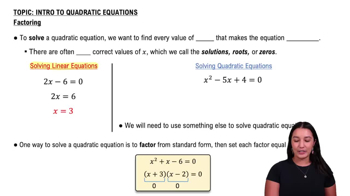
Factoring involves rewriting polynomials as products of simpler expressions. Recognizing common factors or special products like difference of squares helps simplify rational expressions by canceling common terms in numerator and denominator.
추천 영상:
6:08
Factoring

Simplifying Rational Expressions

A rational expression is simplified by factoring numerator and denominator and canceling out common factors. This process reduces the expression to its lowest terms, making it easier to work with or evaluate.
추천 영상:
2:58
Rationalizing Denominators

Domain Restrictions in Rational Expressions

The domain of a rational expression excludes values that make the denominator zero. Identifying these restrictions is essential to avoid undefined expressions and to correctly state the simplified form's valid input values.
추천 영상:
2:58
Rationalizing Denominators