How does a decrease in government spending affect the aggregate expenditure (AE) line in the Aggregate Expenditures Model?
A decrease in government spending lowers one of the constant components of aggregate expenditures, causing the AE line to shift downward by the amount of the decrease. This reduces total spending in the economy and, through the multiplier effect, can lead to a larger decrease in equilibrium GDP.
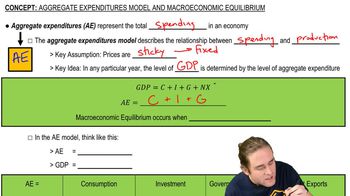
What key assumption about prices is made in the Aggregate Expenditures Model?
The model assumes that prices are sticky, meaning they are fixed and do not change.
In the Aggregate Expenditures Model, what does equilibrium mean?
Equilibrium occurs when aggregate expenditures equal GDP, meaning total spending matches total production.
How is real GDP used in the Aggregate Expenditures Model?
Real GDP is used to measure production while keeping prices constant, excluding the effects of inflation.
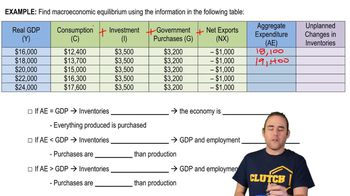
Which component of aggregate expenditures is directly influenced by changes in disposable income?
Consumption is directly influenced by changes in disposable income.
How do investment, government purchases, and net exports behave in the AE model compared to consumption?
They are treated as constants, unlike consumption which increases with disposable income.
What does the marginal propensity to consume (MPC) represent in the consumption function?
The MPC represents the fraction of each additional dollar of disposable income that is spent on consumption.
What happens to consumption as GDP increases in the AE model?
As GDP increases, consumption also increases because higher production leads to higher income.
What is the formula for aggregate expenditures in this model?
Aggregate expenditures are calculated as consumption plus investment plus government purchases plus net exports.
What effect does a change in investment, government purchases, or net exports have on GDP in the AE model?
A change in any of these components can trigger the multiplier effect, causing a larger change in equilibrium GDP.