Costs of Inflation: Shoe-leather Costs and Menu Costs quiz #1 Flashcards
Costs of Inflation: Shoe-leather Costs and Menu Costs quiz #1
You can tap to flip the card.
Control buttons has been changed to "navigation" mode.
1/10
Terms in this set (10)
How can inflation impose significant costs and adversely affect individuals and businesses?
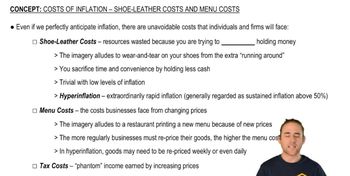
Inflation imposes costs such as shoe-leather costs (resources wasted making frequent bank trips to avoid holding depreciating cash), menu costs (expenses businesses incur updating prices), and tax costs (taxation on nominal gains that don't reflect real increases in purchasing power). These costs reduce efficiency and convenience, and are especially severe during hyperinflation.
What is the main reason people incur shoe-leather costs during periods of inflation?
People incur shoe-leather costs because they want to avoid holding cash that is rapidly losing value due to inflation.
How does hyperinflation affect the frequency and severity of shoe-leather and menu costs?
Hyperinflation greatly increases both the frequency and severity of shoe-leather and menu costs, as prices change rapidly and people must constantly adjust their cash holdings and businesses must frequently update prices.
Why is holding cash considered inconvenient during high inflation?
Holding cash is inconvenient during high inflation because its value decreases quickly, requiring more frequent trips to the bank and making it harder to make purchases without carrying large amounts of money.
What is the origin of the term 'menu cost' in the context of inflation?
The term 'menu cost' comes from the expense restaurants face when they have to print new menus to reflect changing prices due to inflation.
How do businesses sometimes try to minimize menu costs?
Businesses may use stickers to cover old prices instead of printing entirely new menus or price tags to reduce menu costs.
What is meant by 'phantom income' in the context of inflation and taxes?
Phantom income refers to nominal gains that result from inflation rather than real increases in value, leading to taxation on income that does not represent actual purchasing power gains.
Why might someone be taxed on a gain that does not increase their real purchasing power during inflation?
Because tax systems often tax nominal gains, not accounting for inflation, so increases in asset values due solely to inflation can result in taxes on illusory profits.
In what historical situations has hyperinflation occurred, as mentioned in the lesson?
Hyperinflation has occurred in post-World War I Germany and in Zimbabwe, among other places.
Why are shoe-leather and menu costs usually trivial during periods of low inflation?
During low inflation, price changes are infrequent and small, so the inconvenience and expenses associated with adjusting cash holdings and updating prices are minimal.