Demand-Pull and Cost-Push Inflation quiz #1 Flashcards

Demand-Pull and Cost-Push Inflation quiz #1
Control buttons has been changed to "navigation" mode.
1/10
  • How does demand-pull inflation differ from cost-push inflation?
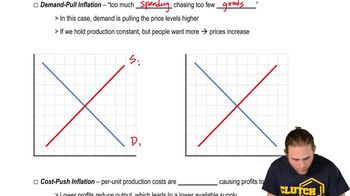
    Demand-pull inflation occurs when increased demand for goods and services leads to higher prices, especially when supply cannot increase to meet the demand. In contrast, cost-push inflation is caused by rising production costs (such as higher raw material prices), which reduce firms' profits and output, leading to higher prices due to decreased supply. The key difference is that demand-pull inflation is driven by increased demand, while cost-push inflation is driven by increased costs to producers.
  • What happens to the equilibrium price and quantity when demand increases but supply remains constant?
    The equilibrium price rises while the quantity supplied stays the same, resulting in higher prices without increased production.
  • In demand-pull inflation, what is meant by 'too much spending chasing too few goods'?
    It means that demand for goods and services exceeds the available supply, causing prices to rise.
  • How is a supply shock related to cost-push inflation?
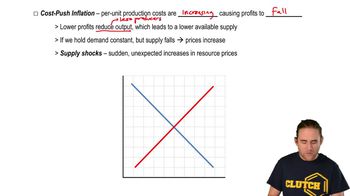
    A supply shock, such as a sudden increase in raw material costs, reduces supply and pushes prices higher, leading to cost-push inflation.
  • What typically happens to firm profits during cost-push inflation?
    Firm profits decrease because production costs rise, which can lead to some firms leaving the industry.
  • When supply decreases and demand is held constant, what happens to the market equilibrium?
    The equilibrium price increases and the equilibrium quantity decreases.
  • Why might output not increase during demand-pull inflation even though demand rises?
    Output does not increase because supply is held constant and cannot meet the higher demand.
  • What is the graphical effect of a leftward shift in the supply curve on price?
    A leftward shift in the supply curve leads to a higher equilibrium price and a lower equilibrium quantity.
  • How does a decrease in the number of producers affect supply and prices?
    A decrease in the number of producers reduces supply, which in turn raises prices.
  • What is the main similarity between demand-pull and cost-push inflation?
    Both result in higher prices, though they are caused by different factors—either increased demand or increased production costs.