Skip to main content
Macroeconomics
My Course
Learn
Exam Prep
AI Tutor
Study Guides
Flashcards
Explore
Try the app
My Course
Learn
Exam Prep
AI Tutor
Study Guides
Flashcards
Explore
Try the app
Back
Differences in Wages quiz
You can tap to flip the card.
What is a compensating differential in the context of wages?
You can tap to flip the card.
👆
What is a compensating differential in the context of wages?
A compensating differential is extra pay offered to workers to compensate for unpleasant or risky aspects of a job.
Track progress
Control buttons has been changed to "navigation" mode.
1/15
Related flashcards
Recommended videos
Differences in Wages definitions
Differences in Wages
13 Terms
Guided course
02:39
Differences in Wages:Compensating Differential and Human Capital
4
views
Guided course
04:12
Differences in Wages:Efficiency Wages and Superstars
2
views
Terms in this set (15)
Hide definitions
What is a compensating differential in the context of wages?
A compensating differential is extra pay offered to workers to compensate for unpleasant or risky aspects of a job.
Why might a construction worker earn more than a retail worker?
Construction work is riskier and more physically demanding, so higher wages compensate for these unpleasant aspects.
How does human capital affect a worker's wage?
Higher human capital, such as more education or training, increases productivity and leads to higher wages.
What is meant by the term 'efficiency wage'?
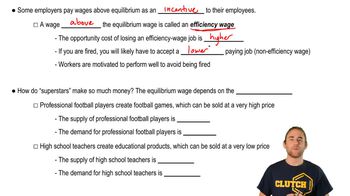
An efficiency wage is a wage paid above the market equilibrium to motivate higher productivity and reduce employee turnover.
Why would an employer pay an efficiency wage?
Employers pay efficiency wages to incentivize employees to work harder and to attract and retain the best workers.
What is the opportunity cost of losing an efficiency wage job compared to a regular job?
The opportunity cost is higher because the worker would have to accept a lower wage elsewhere if they lose the higher-paying efficiency wage job.
How does the supply and demand for professional athletes affect their wages?
Professional athletes have high wages because there is high demand for their unique talents and a low supply of qualified individuals.
Why do high school teachers generally earn less than professional athletes?
High school teachers face lower demand and higher supply for their skills, and the educational product they provide is sold at a lower price.
What does 'derived demand' mean in the context of labor markets?
Derived demand means that the demand for labor depends on the demand for the goods or services that labor helps produce.
How does the price of the good produced affect wages in different professions?
Professions producing goods sold at high prices, like sports events, can pay higher wages than those producing lower-priced goods, like education.
What role does unpleasant management play in wage differences?
Unpleasant management can require higher wages to attract and retain workers willing to tolerate the negative work environment.
How does the equilibrium wage relate to efficiency wages?
Efficiency wages are set above the equilibrium wage to encourage better performance and reduce turnover.
What is the effect of a surplus of labor supply on efficiency wage jobs?
A surplus of labor supply allows employers to select the best employees for efficiency wage jobs.
Why might two people in the same job earn different wages?
Differences in working conditions, human capital, or employer practices like efficiency wages can lead to wage differences even within the same job.
What is the 'superstar effect' in wage determination?
The superstar effect occurs when individuals with unique talents and high demand, but low supply, earn exceptionally high wages.
 BackBack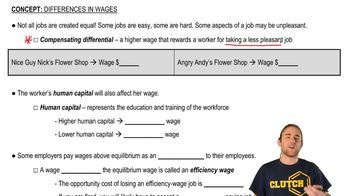
 02:39
02:39