What is the main advantage of using the midpoint method to calculate price elasticity of demand?
The midpoint method gives a consistent elasticity value regardless of whether the price increases or decreases.
What is the formula for price elasticity of demand using the midpoint method?
It is the percentage change in quantity demanded divided by the percentage change in price, with both percentage changes calculated using average values.
How do you calculate the average quantity in the midpoint method?
Add the two quantities and divide by two.
How do you calculate the average price in the midpoint method?
Add the two prices and divide by two.
What is the first step in the step-by-step method for the midpoint formula?
Subtract the two quantities and subtract the two prices.
What is the second step in the step-by-step method for the midpoint formula?
Sum the two quantities and sum the two prices.
What is the third step in the step-by-step method for the midpoint formula?
Divide the sum of the quantities by 2 and the sum of the prices by 2 to get the averages.
What is the fourth step in the step-by-step method for the midpoint formula?
Divide the difference in quantity by the average quantity, and the difference in price by the average price.
In the pizza company example, what was the change in quantity demanded when the price increased from \$5 to \$6?
The quantity demanded decreased from 2,000 to 1,400, a change of 600 units.
What was the average price in the pizza company example using the midpoint method?
The average price was \$5.50.
What was the percentage change in quantity demanded in the pizza company example?
It was 0.353, or 35.3%.
What was the percentage change in price in the pizza company example?
It was 0.182, or 18.2%.
How do you interpret an elasticity of demand greater than 1?
It means demand is elastic, so quantity demanded is very sensitive to price changes.
Why is it important to follow the step-by-step method when using the midpoint formula?
It helps avoid calculation errors and ensures accuracy in finding elasticity.
What does it mean if the quantity demanded changes more than the price in percentage terms?
It indicates that demand is elastic, as consumers are highly responsive to price changes.
 Back
Back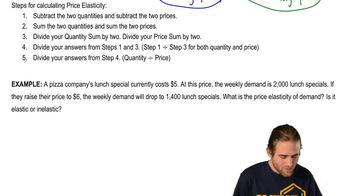
 10:04
10:04