Skip to main content
Macroeconomics
My Course
Learn
Exam Prep
AI Tutor
Study Guides
Flashcards
Explore
Try the app
My Course
Learn
Exam Prep
AI Tutor
Study Guides
Flashcards
Explore
Try the app
Back
Four Market Model Summary: Oligopoly definitions
You can tap to flip the card.
Oligopoly
You can tap to flip the card.
👆
Oligopoly
A market structure with few firms, high entry barriers, and firms that influence price and output through strategic interactions.
Track progress
Control buttons has been changed to "navigation" mode.
1/15
Related flashcards
Recommended videos
Four Market Model Summary: Oligopoly quiz
Four Market Model Summary: Oligopoly
15 Terms
Guided course
03:39
Four Market Model Summary: Oligopoly
5
views
Terms in this set (15)
Hide definitions
Oligopoly
A market structure with few firms, high entry barriers, and firms that influence price and output through strategic interactions.
Market Power
The ability of a firm to influence the price and output levels in its market, often resulting in long-run profitability.
Barriers to Entry
Obstacles that prevent new firms from easily entering an industry, maintaining the dominance of existing firms.
Game Theory
A framework for analyzing strategic interactions where the outcome for each participant depends on the actions of others.
Interdependence
A situation where each firm's decisions affect and are affected by the actions of rival firms in the market.
Downward-Sloping Demand Curve
A graphical representation showing that as price decreases, quantity demanded increases, typical in imperfect competition.
Marginal Cost
The additional expense incurred from producing one more unit of output, crucial for profit-maximizing decisions.
Marginal Revenue
The extra income received from selling one more unit, always below price in markets with downward-sloping demand.
Profit Maximizing Output
The quantity of production where firms achieve the highest possible profit, often requiring strategic consideration in oligopolies.
Long-Run Profitability
The sustained ability of firms to earn profits over time due to limited competition and high entry barriers.
Price Setting
The process by which firms determine the selling price of their goods, often influenced by competitors’ actions.
Imperfect Competition
A market scenario where individual firms have some control over price, unlike perfect competition.
Market Structure
The organizational and competitive characteristics of a market, such as the number of firms and entry barriers.
Monopoly
A market with a single firm, serving as a contrast to oligopoly, where only one seller dominates.
Perfect Competition
A market structure with many firms, identical products, and no barriers to entry, leading to price equaling marginal cost.
 BackBack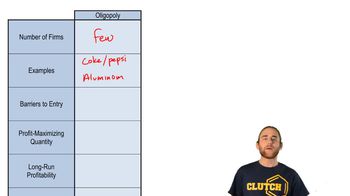
 03:39
03:39