A goal of monetary policy and fiscal policy is to:
Promote price stability (control inflation) and achieve high employment, ensuring the economy operates at its potential level.
Who is responsible for managing the money supply in the United States?
The Federal Reserve, which is the central bank of the United States, manages the money supply.
What are M1 and M2 in the context of monetary policy?
M1 and M2 are measures of the money supply, with M1 including cash and checking deposits, and M2 including M1 plus savings deposits and other near-money assets.
Why is price stability important for the function of money?
Price stability ensures that money retains its value, allowing it to serve as a medium of exchange and a store of value.
How does high employment relate to the goals of monetary policy?
High employment ensures that resources are fully utilized, keeping GDP at its potential level.
What role does the Fed play during financial market instability?
The Fed acts as a lender of last resort to help stabilize financial markets and prevent failures.
How does the interest rate affect firm investment according to monetary policy?
Higher interest rates make loans more expensive, reducing firm investment, while lower rates encourage more investment.
What was a significant change in the Fed's role during the 2008 financial crisis?
During the 2008 crisis, the Fed expanded its support from just commercial banks to also include investment banks.
Why is economic growth considered a goal of monetary policy?
Economic growth is promoted by managing interest rates to encourage firm investment, which is essential for increasing output and prosperity.
What happens to investment when the Fed raises interest rates?
When the Fed raises interest rates, loans become costlier, leading to a decrease in investment by firms.
When inflation is high, what action does the Federal Reserve typically take to slow the economy?
When inflation is high, the Federal Reserve aims to slow the economy by raising interest rates, making loans more expensive, which reduces investment and spending.
What does a government's monetary policy aim to control?
A government's monetary policy aims to control the money supply and interest rates to achieve goals such as price stability, high employment, financial market stability, and economic growth.
 Back
Back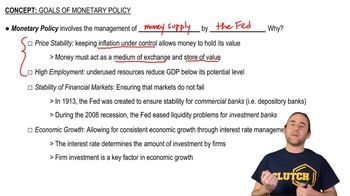
 03:28
03:28